

Radiology AI 510(k) Clearances: November vs. October 2026 Overview
Every radiology AI 510(k) clearance from October 2026 and November 2026 to date—names, descriptions, intended use and verified FDA links—plus what the shift means for founders, regulatory teams, market access and investors.
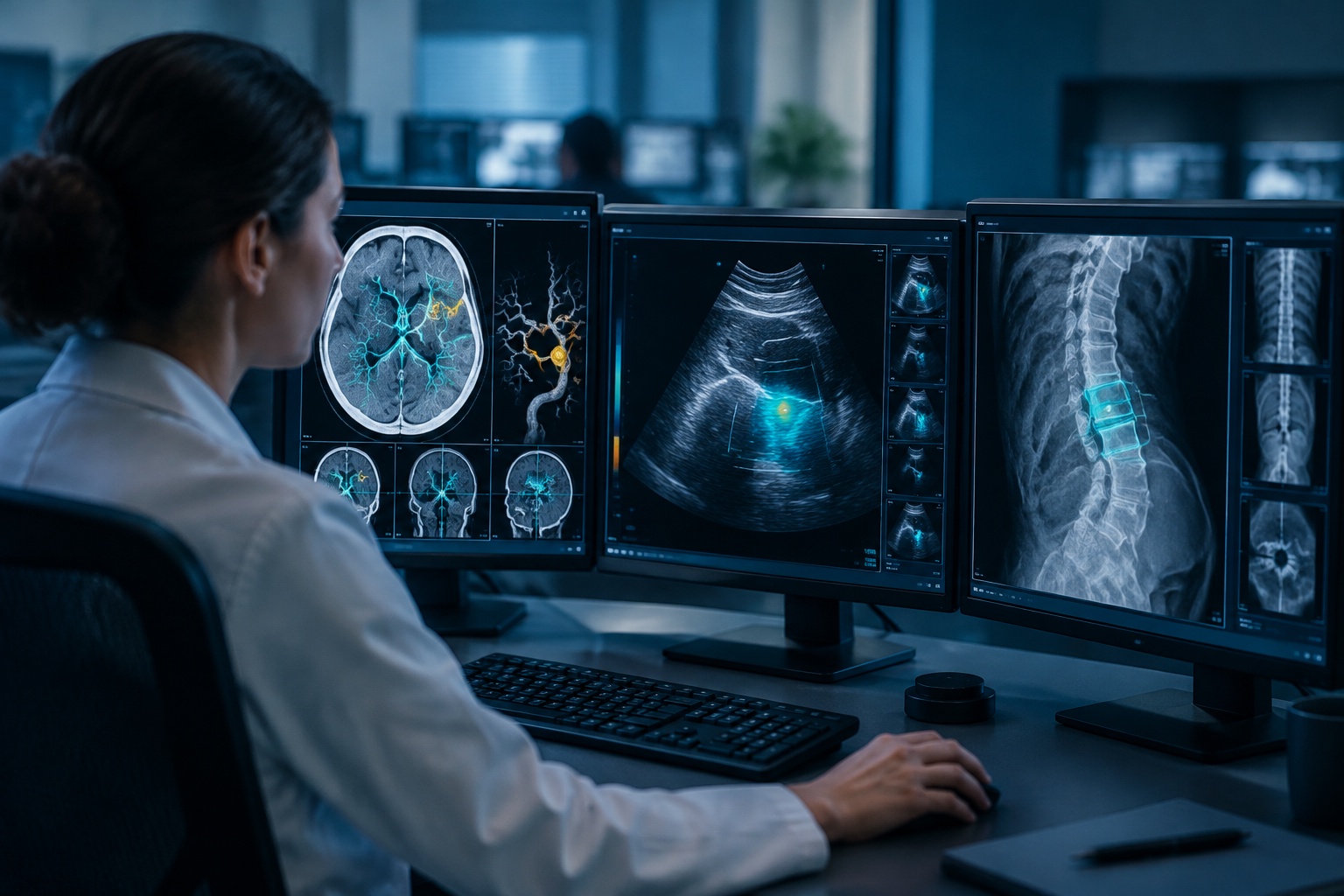
Radiology remains the largest category of FDA-authorized AI-enabled medical devices. To track that pipeline, we reviewed every radiology-related 510(k) clearance with an FDA decision date in October 2026 and November 2026 to date, using the RadAI Slice FDA device tracker as the starting list and confirming each number, device name, applicant, decision date and product code against openFDA's 510(k) records.
The short answer: October 2026 recorded 19 radiology-related 510(k) clearances; November 2026 shows 4 so far, all with FDA decision dates of November 4–6. FDA posts decisions with a lag, so November is a month-to-date snapshot, not a full-month result. The useful comparison is not the raw count—it is what kind of products cleared and what that says about the path to adoption.
How we built this list
- Scope: 510(k) clearances tagged to radiology imaging on the tracker, including several cardiovascular, neurology and ENT-panel products that rely on imaging. A few entries are imaging hardware or surgical navigation rather than stand-alone AI algorithms; we flag them rather than drop them.
- Dates: FDA decision dates from openFDA. Third-party trackers sometimes display a date one day earlier.
- Descriptions and intended use: Plain-language summaries derived from each product code and public device summaries. They are not the cleared Indications for Use. Read the official 510(k) summary (linked) before citing a claim.
November 2026 radiology AI 510(k) clearances (to date)
Swipe horizontally to see all columns.
| Device (manufacturer) | FDA decision | Description | Intended use (summary) | 510(k) |
|---|---|---|---|---|
| CadAI-B Dx (BeamWorks) | Nov 6, 2026 | AI detection/diagnosis software for lesions suspicious for cancer (QDQ) | Assists radiologists in identifying and characterizing suspicious lesions; adjunct to physician reading | K263749 |
| MAGNETOM Free.XL (Siemens Healthineers) | Nov 5, 2026 | MRI system (LNH); imaging hardware rather than a stand-alone AI algorithm | Produces MR images of internal body structures for interpretation by trained physicians | K262011 |
| Clever One (Ewoosoft) | Nov 4, 2026 | Automated radiological image processing software (QIH) | Processes and analyzes radiological images to support clinician interpretation | K260372 |
| PeekMed® web (Peek Health) | Nov 4, 2026 | Automated image processing with musculoskeletal X-ray segmentation (QIH) | Supports clinicians in analyzing musculoskeletal images, including pre-operative planning workflows | K262667 |
October 2026 radiology AI 510(k) clearances
Swipe horizontally to see all columns.
| Device (manufacturer) | FDA decision | Description | Intended use (summary) | 510(k) |
|---|---|---|---|---|
| EFAI NeuroSuite CTA LVO Assessment System (Ever Fortune.AI) | Oct 30, 2026 | Computer-assisted triage and notification software (QAS) for head CTA | Flags suspected large vessel occlusion for prioritized review; does not replace diagnosis | K263109 |
| DS Core Detect (Dentsply Sirona) | Oct 30, 2026 | Medical image analyzer (MYN) for CT-based detection | Assists clinicians in detecting findings on dental/maxillofacial imaging | K261072 |
| Cleerly ISCHEMIA (Cleerly) | Oct 29, 2026 | Adjunctive epicardial vascular physiologic status indicator (QXZ) from coronary CTA | Estimates likelihood of ischemia-causing coronary disease to support cardiac evaluation | K262839 |
| Evident Vascular Guidance System (Evident Vascular) | Oct 28, 2026 | Pulsed-echo ultrasonic imaging system (IYO) with vascular detection | Provides ultrasound imaging guidance in vascular procedures | K261648 |
| uPMR Zenith (United Imaging Healthcare) | Oct 28, 2026 | Combined PET/MR imaging system (OUO) with image reconstruction | Acquires and reconstructs whole-body PET and MR images for clinical interpretation | K261676 |
| OsteoSight Spine (v1) (Naitive Technologies) | Oct 27, 2026 | Opportunistic low bone mineral density software (SAO) on spine X-ray | Flags patients who may have low bone mineral density from existing radiographs for follow-up | K261512 |
| MIM KineticID (MIM Software) | Oct 26, 2026 | Radiological image processing system (LLZ) for dynamic PET quantification | Supports visualization, registration and pharmacokinetic quantification of PET for diagnosis and treatment planning | K261763 |
| NeuroAlign (Medivis) | Oct 26, 2026 | Neurological stereotaxic instrument (HAW) using CT/MRI with optical tracking | Guides instrument positioning during cranial surgery | K261997 |
| OTOPLAN (Cascination) | Oct 23, 2026 | Image management software for otologic/neurotologic planning (QQE) | Supports surgical planning of ear and lateral skull-base procedures from patient imaging | K262080 |
| BlineSlide (Deep Breathe) | Oct 23, 2026 | AI detection software (POK) for lung ultrasound | Assists clinicians in identifying lung-ultrasound findings such as B-lines | K261679 |
| PV-iCurve Pro (Perception Vision Medical Technology) | Oct 21, 2026 | Radiological image processing system (LLZ) with multimodality detection | Supports image review, contouring and analysis across modalities | K261531 |
| CINA-Aneurysm (Avicenna.AI) | Oct 20, 2026 | CT detection software (QBS product code) for brain aneurysm | Assists in detecting suspected intracranial aneurysms on CT angiography | K262062 |
| CINA-Aneurysm+ (Avicenna.AI) | Oct 19, 2026 | Automated radiological image processing software (QIH) for brain aneurysm | Provides automated aneurysm analysis and measurement on CT angiography | K262147 |
| AVIEW Aorta Metrics (Coreline Soft) | Oct 16, 2026 | CT system software (JAK) for aortic segmentation | Segments and measures the aorta on CT to support vascular assessment | K260391 |
| Rapid ICH (v4.0) (iSchemaView (RapidAI)) | Oct 9, 2026 | Computer-assisted triage and notification software (QAS) | Flags non-contrast head CT studies with suspected intracranial hemorrhage for prioritized review | K262301 |
| NeuroDR (Deep Reasoning AI) | Oct 7, 2026 | Automated radiological image processing software (QIH) for brain MRI | Supports detection and analysis of neurological findings on MRI | K262134 |
| Ligence Heart (Ligence) | Oct 7, 2026 | Automated image processing software (QIH) for echocardiography | Segments cardiac structures and automates echocardiographic measurements | K261733 |
| QGuideCT (1.0) (Medis Medical Imaging) | Oct 5, 2026 | Automated radiological image processing software (QIH) for CT | Supports CT image analysis and detection for physician review | K260523 |
| Lung Guidance (GE HealthCare) | Oct 2, 2026 | AI-guided image acquisition/optimization (QJU) for lung ultrasound | Guides users in acquiring diagnostic-quality lung ultrasound images | K261042 |
October vs. November: what changed
Swipe horizontally to see all columns.
| Measure | October 2026 | November 2026 (to date) |
|---|---|---|
| Radiology-related 510(k) clearances | 19 | 4 |
| Stroke and neuro imaging (triage, aneurysm, MRI, navigation, skull-base planning) | 7 | 0 |
| Automated image processing (product code QIH) | 4 | 2 |
| Cancer lesion detection/diagnosis (QDQ) | 0 | 1 |
| Imaging hardware (MRI or PET/MR systems) | 1 | 1 |
| Ultrasound-based AI or guidance | 4 | 0 |
| Musculoskeletal X-ray (bone density, segmentation) | 1 | 1 |
October was a neuro-heavy month. Two triage-and-notification products (EFAI LVO and Rapid ICH v4.0), two Avicenna.AI aneurysm tools and NeuroDR brain-MRI software illustrate how crowded acute neuro imaging has become. New entrants there compete on workflow integration, site coverage and evidence of time-to-treatment impact—not on first-mover status.
Ultrasound AI kept growing. BlineSlide, Lung Guidance, Ligence Heart and the Evident Vascular system show AI moving into acquisition guidance and point-of-care measurement, where the buyer may be emergency medicine, cardiology or critical care rather than radiology.
November opened with oncology and MSK. BeamWorks' CadAI-B Dx and Peek Health's PeekMed web point to steady demand in cancer detection and orthopedic planning. Two of four early-November entries are general image-processing (QIH) clearances, the most common radiology AI product code in both months.
Iterations matter. "v4.0", "+" and "v1" labels are reminders that many clearances are updates to existing products. For AI developers, planned model changes are where a predetermined change control plan (PCCP) can reduce repeated submissions.
Key takeaways for Cahir MedTech stakeholders
Founders and product leaders
Choose your predicate and product code early. QIH, QAS and LLZ each carry different expectations for performance testing and labeling. Reviewing recent clearances in the same code is the fastest way to see how competitors framed intended use. Our FDA regulatory pathways guide walks through 510(k), De Novo and PMA trade-offs.
Regulatory and quality teams
Repeat clearances signal that change management is a core competency. Align your design controls and software validation with the QMSR, and decide what a PCCP will cover before the first submission. See the eSTAR 510(k) submission readiness checklist and the AI/ML PCCP guide.
Commercial, market-access and business development leaders
Clearance is not payment. Most of these products are paid within a facility bundle, so the hospital buyer needs a workflow, quality or cost argument. For inpatient technologies with high incremental cost, start with our NTAP founders guide and screen the cost criterion with the NTAP Analyzer. Crowded categories like stroke triage also benefit from competitive and claims intelligence in MedTech Compass.
Investors and partners
Count matters less than concentration. Neuro triage is saturated; acquisition guidance, opportunistic screening (such as bone density on routine X-rays) and quantitative PET/cardiac tools are less crowded. Diligence should test differentiation within the product code, not just the presence of a clearance. Our AI device evaluation service frames that review.
Follow new entries as they post on AI Device Updates.
Radiology AI 510(k) clearances: quick answers
How many radiology AI 510(k) clearances were there in October 2026?
We counted 19 radiology-related 510(k) clearances with FDA decision dates from October 2 to October 30, 2026, verified against openFDA records.
How many radiology AI devices has FDA cleared in November 2026?
Four as of this article's publication, with decision dates of November 4–6, 2026. FDA posts decisions with a delay, so the November total is likely to rise.
Which radiology AI categories were most active?
Neuro imaging led October with seven clearances, including stroke triage and aneurysm detection. Automated radiological image processing (product code QIH) was the most common product code across both months.
Does a 510(k) clearance mean the device is reimbursed?
No. Clearance addresses safety and effectiveness relative to a predicate. Coverage, coding and payment are separate decisions made by CMS, contractors and private payers.
Where can I verify a specific clearance?
Use the linked FDA 510(k) database entry for each K-number. It provides the decision date, applicant, product code and the 510(k) summary or statement.
Primary sources and applicability
- FDA 510(k) Premarket Notification database: official clearance records and summaries.
- openFDA device 510(k) API: used to verify K-numbers, applicants, decision dates and product codes.
- FDA AI-enabled medical devices list: FDA's periodically updated list of AI-enabled devices.
- RadAI Slice FDA tracker: third-party list used to identify radiology entries.
This article is educational guidance, not regulatory, legal or reimbursement advice. Device descriptions and intended-use summaries are simplified; rely on each device's official 510(k) summary and labeling. Publication date: November 23, 2026; data checked November 24, 2026, covering FDA decision dates through November 6, 2026.
New to a term? See the MedTech regulatory glossary for plain-English definitions.
Originally published at the source article.
Follow MedTech Insights
New articles on FDA 510(k) and De Novo pathways, CE Mark and EU MDR, and device reimbursement — sent to your inbox as they publish.