
Interactive guide
21 CFR Part 11 and electronic records compliance for SaMD, CDS and AI-enabled devices
Most Part 11 material is written for paper-era pharma. This guide is written for software that touches regulated decisions: which of your records are actually Part 11 records, what ALCOA+ data integrity means for a model version register, what an immutable audit trail has to capture, and how electronic signatures work. Four browser-only tools let you test your own position as you read.
What 21 CFR Part 11 actually covers
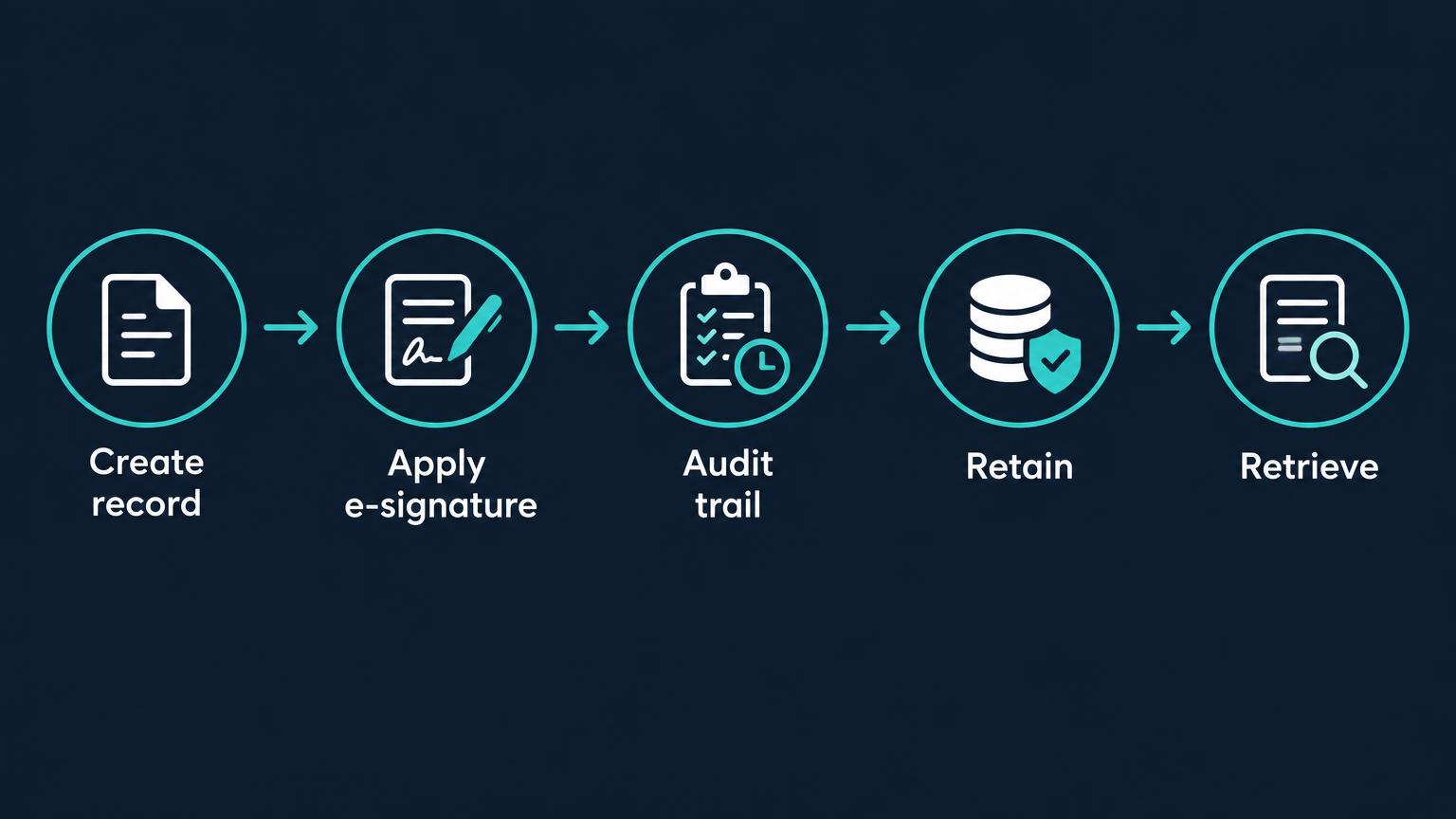
Part 11 sets the conditions under which FDA accepts electronic records and electronic signatures as equivalent to paper records and handwritten signatures. It is not a standalone obligation to keep records. It attaches to records that another regulation — the predicate rule — already requires you to maintain or submit. For a device software company the predicate rules are the quality system requirements now harmonised with ISO 13485 under the Quality Management System Regulation, plus reporting and complaint requirements.
That single point decides most scoping arguments. If a regulation requires the record and you keep it electronically, Part 11 applies: validate the system, control access, keep a secure computer-generated audit trail, and if anyone signs it, apply the signature controls. If no regulation requires it, Part 11 does not apply — although good data integrity practice still does, because working records have a habit of becoming evidence.
Which records are Part 11 records?
A working map for software teams. The right-hand columns are the two questions people most often get wrong: whether an audit trail is required, and whether a signature is.
| Record | Part 11 record? | Audit trail | Electronic signature |
|---|---|---|---|
| Design history file and design controls | Yes | Yes | Yes — design reviews and approvals |
| Software validation and verification results | Yes | Yes | Yes — test approval |
| Model version register and release records | Yes | Yes | Yes — release authorisation |
| Training data provenance and dataset lineage | Yes, where relied on as design evidence | Yes | Usually not |
| Complaints, CAPA and post-market surveillance | Yes | Yes | Yes — investigation closure |
| Inference logs used to support performance claims | Yes, when retained as evidence | Yes | No |
| CDS recommendation shown to a clinician | Generally no — clinical data under other rules | Recommended | No |
| Marketing material and internal working notes | No | No | No |
ALCOA+ data integrity, attribute by attribute
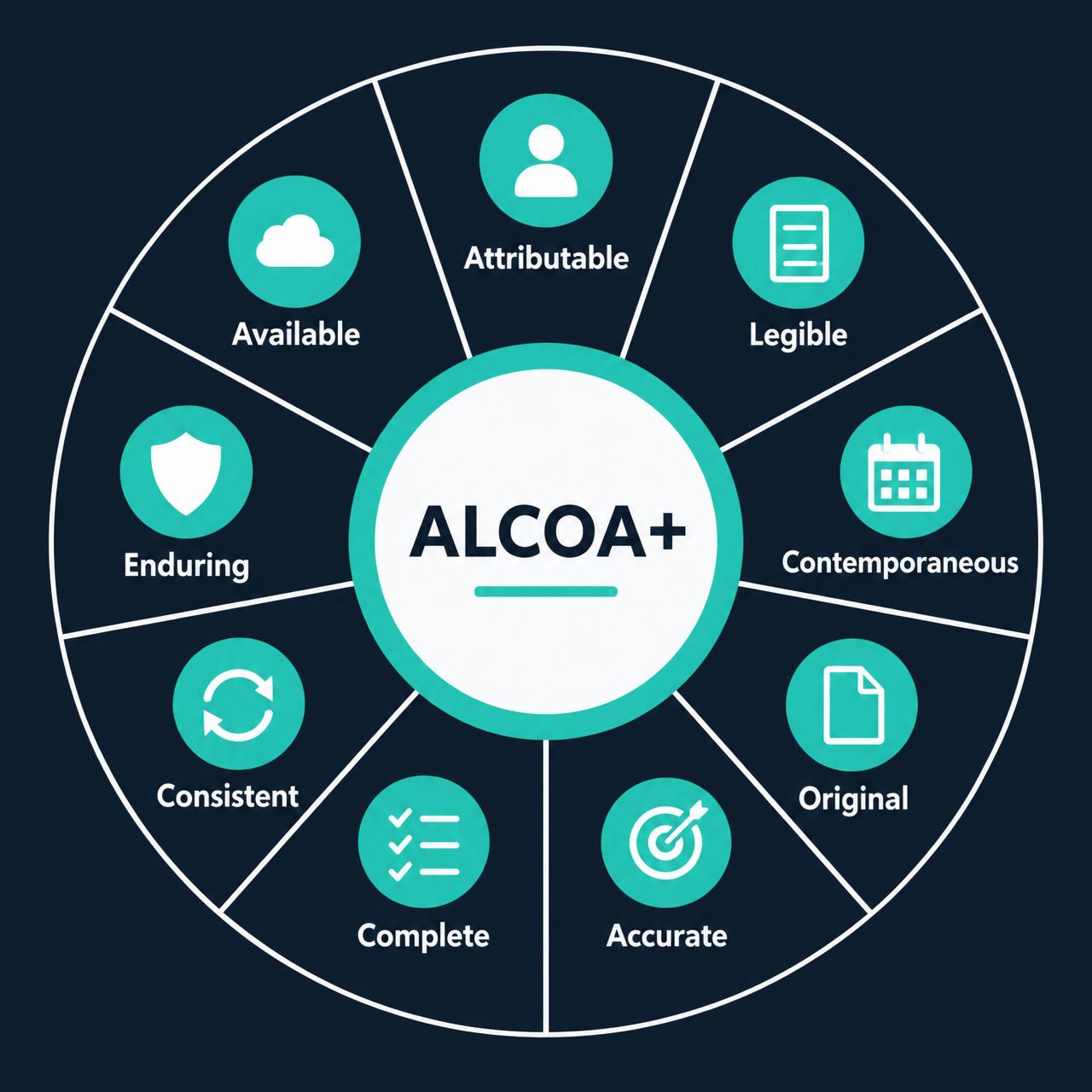
ALCOA+ is the language inspectors use when they ask whether your records can be trusted. Part 11 controls are how you answer. Each attribute below is paired with the control that evidences it in a software product.
| Attribute | What it means | Control that proves it |
|---|---|---|
| Attributable | You can tell who created or changed the record | Unique named accounts, no shared logins, identity bound to every write |
| Legible | The record can be read and understood for its full life | Human-readable export, documented field meanings, stable formats |
| Contemporaneous | Recorded at the time of the activity | Server-generated timestamps with a fixed time source, no back-dating |
| Original | The first capture, or a verified true copy | Write-once storage of the source record and its checksum |
| Accurate | The record reflects what actually happened | Input validation, review workflow, reconciliation against source systems |
| Complete | Nothing is silently dropped, including repeats and failures | Append-only audit trail capturing deletions and superseded values |
| Consistent | Sequence and format hold across systems | One time zone of record, controlled vocabularies, shared identifiers |
| Enduring | The record survives for its retention period | Retention policy, backup and restore testing, media migration plan |
| Available | It can be produced for review when asked | Inspector-ready search and export of records with their audit trails |
Immutable audit trails and electronic signatures
An audit trail satisfies Part 11 when it is secure, computer-generated and time-stamped, and records who did what and when for creation, modification and deletion of records. It must keep the previous value when something changes, must never obscure earlier entries, must be retained at least as long as the record, and must be available for review and copying. The practical failure mode is not a missing feature — it is an audit trail an administrator can edit, or one that logs the change without the old value.
Electronic signatures carry their own requirements. Each signature needs two distinct identification components at the first signing in a continuous session, and both components at each subsequent signing if the session has lapsed. The signed record must show the printed name of the signer, the date and time, and the meaning of the signature — reviewed, approved, released. Signatures must be permanently linked to the record so they cannot be copied elsewhere, and they cannot be shared or reassigned. Before first use you file the certification required by 11.100(c) with FDA, in paper, with a handwritten signature.
Open and closed systems
| Topic | Closed system | Open system |
|---|---|---|
| Who controls access | The organisation responsible for the records | Access is not controlled by that organisation |
| Typical example | Your validated internal QMS or eDHF platform | Records exchanged through an uncontrolled third-party portal |
| Baseline controls | Validation, audit trail, access control, e-signature controls | All of the closed-system controls |
| Additional controls | None beyond the baseline | Document encryption and, where appropriate, digital signature standards |
Validation: from CSV volume to risk-based assurance
Part 11 requires validation of systems holding regulated records. FDA's Computer Software Assurance guidance changed how that effort should be spent: identify the intended use, assess the risk if the feature fails, then choose an assurance activity proportionate to that risk and keep only the record needed to show it happened. The chart below is the shape teams should aim for.
Direct patient safety or product quality impact
100% of assurance effort
Scripted testing, recorded evidence, independent review, full traceability
Indirect impact on a quality decision
65% of assurance effort
Risk-based scripted testing with lighter documentation
Supporting or administrative function
30% of assurance effort
Unscripted or exploratory testing, issue records only
No quality or safety impact
12% of assurance effort
Vendor assurance plus intended-use confirmation
Illustrative distribution of effort, not a regulatory allocation.
What is different for SaMD, CDS and AI-enabled devices
Software as a medical device
Your design history file, software validation evidence and release approvals usually live entirely in electronic tools. That makes the tooling itself part of your compliance surface: an issue tracker used to record design decisions, or a pipeline used to approve a release, is holding Part 11 records whether or not it was bought for that purpose.
Clinical decision support
The recommendation a clinician sees is clinical data, not a Part 11 record. But the records proving how that recommendation is produced and controlled — the logic version in production, its validation, the basis a clinician can independently review, complaint handling — are quality records. Keep the evidence supporting your position on device status under the same controls; it is the first thing asked for when that position is challenged.
AI-enabled device software functions
AI adds record types the regulation never anticipated: training and evaluation dataset provenance, model version registers, retraining triggers, and inference logs kept to support performance claims. Treat each production model version as a controlled record with a release approval and a traceable link to its validation evidence. If you filed a predetermined change control plan, your Part 11 audit trail is where the change log it promises actually lives — see the PCCP guide for how the two fit together.
Part 11 and EU Annex 11 side by side
Teams selling in both markets rarely need two systems, but they do need to know where the expectations differ. Annex 11 is more explicit about supplier oversight and periodic review; Part 11 is more prescriptive about signature mechanics.
| Topic | 21 CFR Part 11 | EU Annex 11 |
|---|---|---|
| Scope | US electronic records and signatures under a predicate rule | EU computerised systems used in GxP activities |
| Risk basis | Risk-based scope-and-application approach, reinforced by CSA | Explicit risk management across the system lifecycle |
| Suppliers | Handled through your own supplier controls | Named expectation to assess and audit suppliers and service providers |
| Audit trails | Secure, computer-generated, time-stamped, retained with the record | Required for GMP-relevant changes and deletions, regularly reviewed |
| Signatures | Detailed component, manifestation and certification requirements | Equivalent legal weight, permanently linked to the record |
For device-side European requirements, see the EU MDR and UKCA guide.
What Part 11 does not require
- There is no FDA-certified or FDA-approved Part 11 system, and no vendor can sell you compliance.
- Blockchain, biometrics and hardware tokens are options, not requirements.
- An electronic signature does not have to resemble a handwritten one; it has to be attributable, permanently linked and manifested in the record.
- Part 11 does not require you to keep every record electronically — it governs the ones you choose to.
- Validation volume is not the measure. FDA's Computer Software Assurance guidance asks for evidence proportionate to risk.
Interactive Part 11 tools
Four tools you can use straight away. Everything runs in your browser — nothing is stored, sent or logged, and you do not need an account.
Applicability checker
Five questions to work out whether a particular record falls under Part 11. Everything runs in your browser; nothing is stored or sent.
1. Is this record required by a regulation — for example design controls, complaints, CAPA, validation or release approval?
Part 11 only bites on records a predicate rule requires you to keep or submit.
2. Do you keep or submit that record electronically instead of on paper?
A printed, signed master held as the official record moves you outside Part 11 for that record.
3. Does anyone apply an approval or signature to it inside the system?
Approvals, sign-offs and review completions are electronic signatures.
4. Is it a model version, training-data provenance, configuration or release record for an AI-enabled or CDS device?
These are design and production records, and inspectors increasingly ask for them first.
5. Is the record held or exchanged through a system whose access you do not control?
That makes it an open system, which needs encryption and stronger identity controls.
Answer all five questions to see a verdict.
ALCOA+ readiness scorecard
Rate each data integrity attribute against the evidence you could actually show an inspector today.
Overall readiness 0%
Attributable
Not started
Unique named accounts, no shared logins, identity bound to every write
Legible
Not started
Human-readable export, documented field meanings, stable formats
Contemporaneous
Not started
Server-generated timestamps with a fixed time source, no back-dating
Original
Not started
Write-once storage of the source record and its checksum
Accurate
Not started
Input validation, review workflow, reconciliation against source systems
Complete
Not started
Append-only audit trail capturing deletions and superseded values
Consistent
Not started
One time zone of record, controlled vocabularies, shared identifiers
Enduring
Not started
Retention policy, backup and restore testing, media migration plan
Available
Not started
Inspector-ready search and export of records with their audit trails
Weakest areas to fix first
- Attributable — Unique named accounts, no shared logins, identity bound to every write
- Legible — Human-readable export, documented field meanings, stable formats
- Contemporaneous — Server-generated timestamps with a fixed time source, no back-dating
- Original — Write-once storage of the source record and its checksum
- Accurate — Input validation, review workflow, reconciliation against source systems
- Complete — Append-only audit trail capturing deletions and superseded values
- Consistent — One time zone of record, controlled vocabularies, shared identifiers
- Enduring — Retention policy, backup and restore testing, media migration plan
- Available — Inspector-ready search and export of records with their audit trails
Audit trail and e-signature gap checklist
Twenty controls an inspector will look for. Tick off the ones you could evidence today.
0 of 20 complete (0%)
Records
Audit trails
Electronic signatures
Access and accountability
Validation and change
Control summary builder
Pick your situation and the page assembles a tailored electronic records control outline you can take into a working session.
Device type
System type
Risk level
21 CFR Part 11 electronic records control outline
Device type: Software as a medical device (SaMD)
System type: Closed system
Risk level: Direct safety or quality impact

1. Record inventory and scope
   - List each regulated record the system creates, holds or submits.
   - State the predicate rule behind each one.
   - Mark which are Part 11 records and which are working copies.

2. System validation
   - Scripted testing with recorded objective evidence and independent review.
   - Full requirement-to-test traceability, including negative and boundary cases.
   - Define the change control that re-triggers assurance activity.

3. Access control and identity
   - Unique named accounts, no shared logins, documented role permissions.
   - Joiner, mover and leaver process with periodic access review.
   - Authority checks so only permitted roles can sign or release.

4. Audit trail
   - Secure, computer-generated, time-stamped entries for create, modify and delete.
   - Previous values retained; earlier entries never obscured or overwritten.
   - Audit trail retained at least as long as the underlying record.
   - Defined review cadence, and a documented reviewer for exception events.

5. Electronic signatures
   - Two distinct identification components at first signing in a session.
   - Signature manifestation showing printed name, date and time, and meaning.
   - Signature permanently linked to its record and not transferable.
   - 11.100(c) certification letter to FDA on file, with the date it was sent.

6. Records retention, copies and availability
   - Retention period per record type, tied to the predicate rule.
   - Human-readable and electronic copies available for inspection.
   - Backup, restore testing and media migration plan.

7. People and procedures
   - Training records for everyone who creates, modifies or signs records.
   - Written policy holding individuals accountable for their signatures.
   - Deviation, incident and data integrity escalation route.

Educational outline only. It is not regulatory advice and does not replace your
quality system procedures or a review by your regulatory lead.
These tools are educational. They are not regulatory advice and do not replace your quality system procedures or review by a qualified regulatory professional.
Data governance in MedTech Copilot
The controls on this page, built into the tool
MedTech Copilot carries the data governance layer this guide describes: ALCOA+ aligned records, immutable audit trails on every document action, electronic signature capture with signer, timestamp and meaning, versioning across the total product lifecycle, and a change log that lines up with a predetermined change control plan. Lifecycle document drafting and device project tracking sit on the same record spine, so the evidence exists because of how the work was done, not because someone assembled it afterwards.
Frequently asked questions
The eight questions below are the short version. For the full set — scope, ALCOA+ records, audit trails, signatures, validation and enforcement myths — see the dedicated Part 11 FAQ.
- Does 21 CFR Part 11 apply to software as a medical device?
- Part 11 applies to electronic records and electronic signatures that a predicate rule requires you to keep or submit. For a SaMD manufacturer that usually means design history and design controls, complaint and CAPA records, software validation records, training and release approvals held electronically. It is not a blanket rule over everything your product stores; it is a rule about records the regulations already require.
- Is a clinical decision support output a Part 11 record?
- The recommendation itself is generally patient-care data governed by other rules, not a Part 11 record. But the records that prove how that output was produced and controlled — model version in production, release approval, configuration, validation evidence, complaint handling — are quality-system records, and when you keep them electronically Part 11 applies to them.
- What does ALCOA+ mean in practice?
- Attributable, Legible, Contemporaneous, Original and Accurate, plus Complete, Consistent, Enduring and Available. It is the data integrity vocabulary inspectors use. Part 11 controls are how you achieve it: unique user accounts make records attributable, computer-generated timestamps make them contemporaneous, immutable audit trails keep them original and complete, and retention and export controls keep them enduring and available.
- What must an audit trail capture?
- Secure, computer-generated, time-stamped entries that record who did what and when for create, modify and delete actions on electronic records, including the previous value where a record was changed. The audit trail must not obscure earlier entries, must be retained at least as long as the record itself, and must be available for review and copying by an inspector.
- Do I need to send FDA a letter about electronic signatures?
- Yes. Before or at the time you first use electronic signatures, 21 CFR 11.100(c) requires you to certify to FDA, in paper form with a handwritten signature, that electronic signatures in your organisation are the legally binding equivalent of handwritten signatures. It is a one-off certification covering the organisation, not one letter per system.
- How does Computer Software Assurance change validation?
- FDA's Computer Software Assurance guidance shifts effort from documentation volume to risk. High-risk features that directly affect product quality or patient safety get scripted testing and recorded evidence; low-risk features can be covered by unscripted or ad hoc testing with lighter records. The Part 11 obligations themselves are unchanged — you still validate, you just allocate the effort where the risk is.
- What is the difference between an open and a closed system?
- A closed system is one where access is controlled by the people responsible for the records. An open system is one where it is not — for example records exchanged through a third party you do not control. Open systems need the same controls plus additional measures such as document encryption and, where appropriate, digital signature standards.
- Does Part 11 tell me which vendor or technology to use?
- No. Part 11 sets outcomes, not products. There is no FDA-certified Part 11 system, no blockchain requirement, and no obligation to make an electronic signature look like a handwritten one. A vendor claim of being Part 11 compliant describes capability; the compliant use of that capability is still yours to demonstrate.
Sources
- 21 CFR Part 11 — Electronic Records; Electronic Signatures (eCFR)
- FDA guidance: Part 11, Electronic Records; Electronic Signatures — Scope and Application
- FDA guidance: Computer Software Assurance for Production and Quality System Software
- FDA Quality Management System Regulation (QMSR)
- Federal Register — Medical Devices; Quality System Regulation Amendments (QMSR final rule, February 2024)
- FDA guidance: Clinical Decision Support Software
- FDA guidance: Marketing Submission Recommendations for a Predetermined Change Control Plan for AI-Enabled Device Software Functions