

New Technology Add-on Payments (NTAPs): A Guide for Founders and Innovators
New to NTAP? Learn how Medicare’s temporary inpatient add-on payment works, who receives it, the eligibility criteria, application process and limits—and where founders can start.

If you are developing a medical device, diagnostic technology or treatment, getting permission to market it is only part of the journey. Hospitals also need to understand how using it affects the cost of caring for a patient—and how they will be paid.
New Technology Add-on Payment (NTAP) is a temporary Medicare payment that can help a hospital with some of the additional costs of using an approved new technology during a qualifying inpatient stay. It is paid to the hospital, not directly to your company. It does not guarantee coverage, adoption or recovery of the full technology cost.
This guide explains the program from the beginning: why it exists, when it may be relevant, what CMS evaluates and how to approach a first feasibility discussion. You do not need a reimbursement background to follow it.
The discussion draws on Milliman's September 28, 2026 whitepaper, New Technology Add-on Payments (NTAPs): A guide for life sciences organizations, by Peter Heinen, David McManus and Mark Gruenhaupt. We use its insights on evidence, timing and hospital adoption alongside CMS guidance and the governing regulations. The whitepaper provides context; CMS determines eligibility and payment.
What NTAP is—and why the program exists
Medicare is the federal health insurance program that covers many older adults and certain people with disabilities. The Centers for Medicare & Medicaid Services (CMS) administers Medicare and sets the NTAP rules.
For many inpatient hospital stays, Medicare pays through the Inpatient Prospective Payment System (IPPS). Rather than reimbursing every item separately, it generally pays a case-based amount when the patient leaves the hospital. The patient's diagnoses, procedures and other case details determine a Medicare Severity Diagnosis Related Group (MS-DRG)—a category used to set the base payment, with applicable hospital and patient adjustments.
That creates a challenge for innovation. A new implant or treatment can increase the hospital's costs before the historical data used to update these payment categories reflect it. NTAP is a temporary bridge during that gap, not a permanent separate payment for a product.
Imagine a hospital considering a new implant for an inpatient procedure. Its usual case-based payment may not yet reflect the implant's additional cost. If the technology has NTAP approval and the patient's case meets the payment conditions, the hospital may receive an additional payment. The device maker still sells the product to the hospital; CMS does not send the add-on to the manufacturer.
The program has operated for discharges beginning October 1, 2001. It is broader than medical devices: new services and technologies can include drugs, biologics and diagnostic technologies. The relevant use must fit the inpatient payment setting. See the CMS IPPS overview and CMS NTAP program guidance.
NTAP does not establish Medicare coverage, replace FDA marketing authorization or create a separate payment to the manufacturer. Outpatient device pass-through payment follows a different system. Medicare Advantage and commercial contracts also require separate review; do not assume Medicare fee-for-service NTAP rules determine their payments.
Is NTAP relevant to your product?
Start with the setting where the technology will be used. “Inpatient” means a patient has been formally admitted to the hospital; being treated in a hospital building does not necessarily make a visit inpatient. An outpatient procedure or observation stay is not automatically covered by the inpatient NTAP mechanism.
Ask whether your intended use involves Medicare patients admitted to an IPPS hospital, whether it adds costs not yet adequately reflected in the case-based payment, and whether there is evidence of a meaningful clinical advance. These questions identify a potential fit; they do not establish eligibility.
What are the NTAP eligibility criteria?
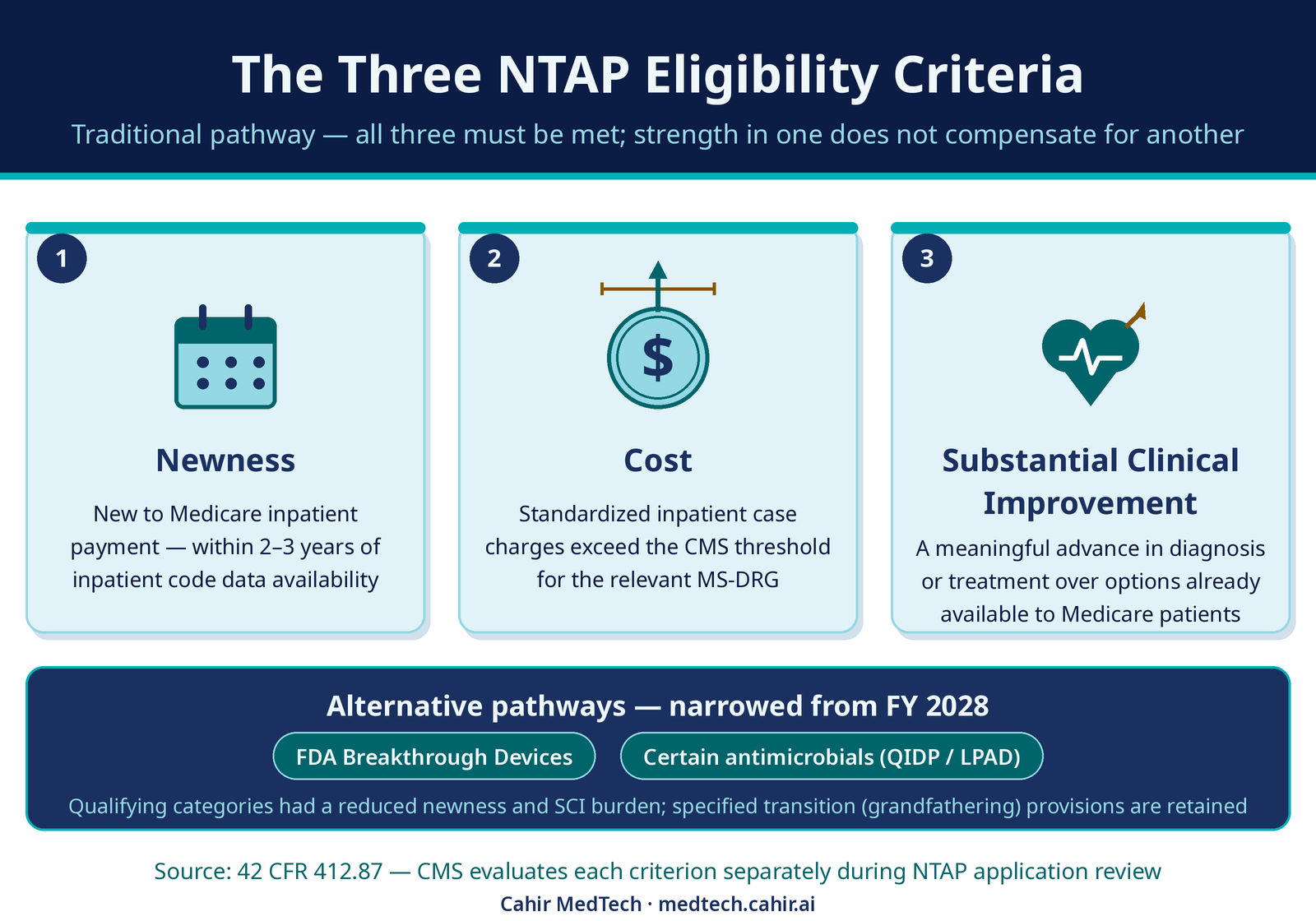
The traditional pathway has three main criteria: newness, cost and substantial clinical improvement. Think of them as separate questions: Is the technology still new for this payment system? Are the relevant inpatient cases sufficiently expensive? Does it improve diagnosis or treatment compared with available options? Meeting one does not compensate for failing another. Certain transitional alternative-pathway provisions are discussed below.
Newness: is it new for Medicare inpatient payment?
Identify the intended patients and procedures, then work with coding and reimbursement specialists to understand the likely MS-DRGs. A tool can suggest candidate groups, but the actual assignment depends on the individual coded case and the applicable grouping software.
“New” here has a payment-system meaning. Under 42 CFR 412.87, a technology may be considered new within two or three years after data begin to become available reflecting its inpatient hospital code, depending on coding and data availability for DRG recalibration. FDA authorization or a new product name alone does not establish NTAP newness.
CMS also examines substantial similarity to existing technology, including mechanism of action, DRG assignment and disease/patient population. Treat the timing as a technology-specific evidence question, not a promise of three paid years after NTAP approval. Commercial availability, claims data and CMS's annual continuation decisions matter.
Cost: do the relevant inpatient cases exceed the CMS threshold?
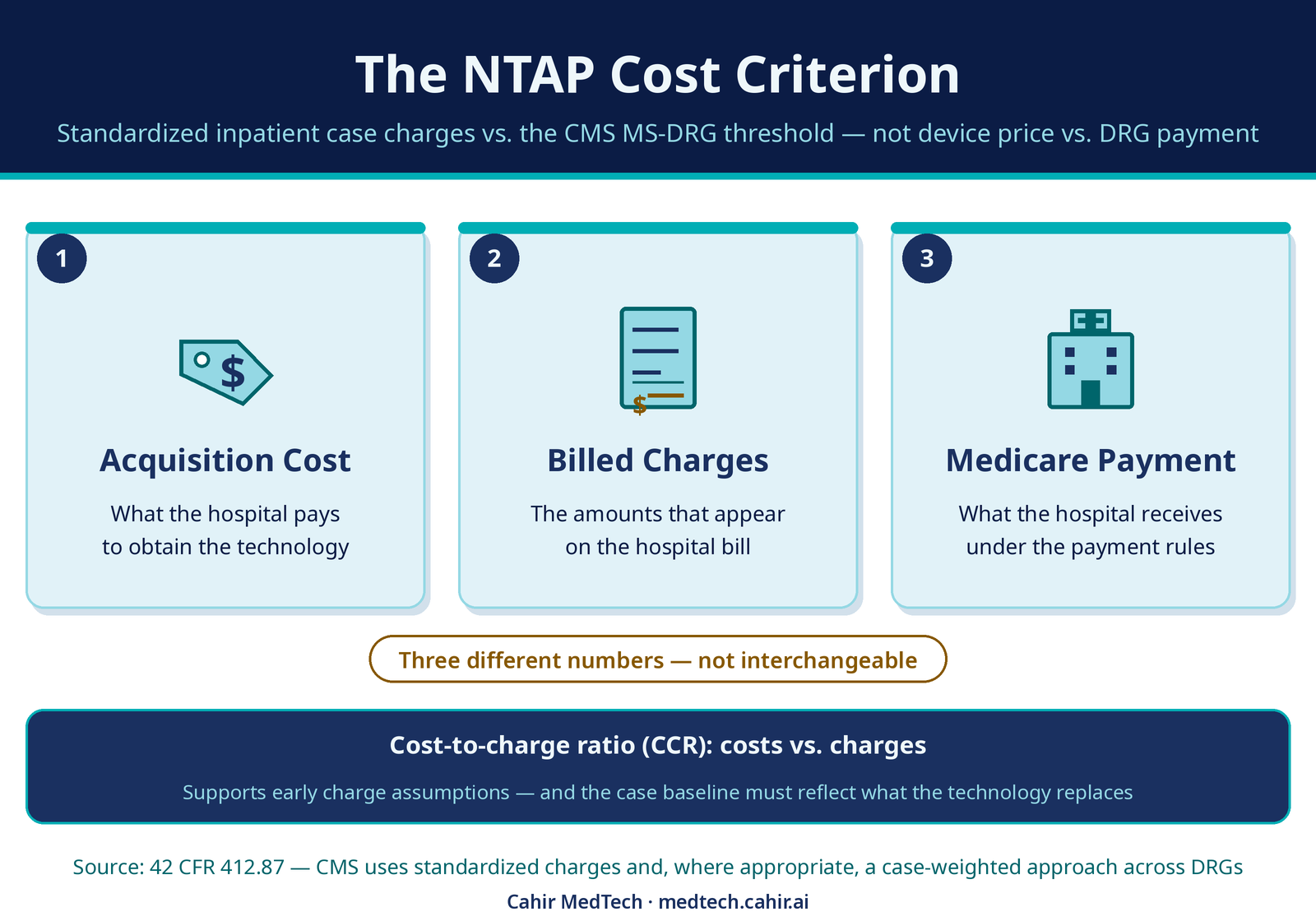
The cost criterion asks whether estimated charges for inpatient cases involving the technology exceed the applicable CMS threshold—a published comparison value for the relevant MS-DRG or groups. It is not a comparison between the device selling price and the DRG payment. CMS uses standardized charges and, where appropriate, a case-weighted approach across relevant DRGs.
Keep three numbers separate. Acquisition cost is what the hospital pays to obtain the technology. Billed charges are the amounts on the hospital bill. Medicare payment is what the hospital receives under the applicable payment rules. They are not interchangeable.
A hospital cost-to-charge ratio (CCR) describes the relationship between costs and charges. It can support early charge assumptions, but does not establish a hospital's actual charge policy or expected reimbursement. The case baseline must also reflect what the technology replaces, rather than simply adding a new device charge to a baseline that already includes the old device.
Use the threshold file for the correct application cycle and check correction notices. The FY 2027 IPPS final-rule files include separately labeled application resources; the rule's fiscal year and the target application year need not match.
For the detailed distinctions, read our CMS NTAP cost-criterion guide. Start with the free NTAP threshold check when you already have a selected DRG and charge assumption. Confirm its displayed reference year. An above-threshold screen is not an NTAP award.
Substantial clinical improvement: what is better for patients?
Substantial clinical improvement (SCI) asks whether the technology offers a meaningful advance in diagnosis or treatment compared with previously available options for Medicare beneficiaries. FDA authorization establishes a different regulatory conclusion; it does not automatically establish CMS's comparative improvement standard.
CMS considers whether a technology offers a treatment option for patients unresponsive to or ineligible for available treatments; enables previously unavailable or earlier diagnosis that affects patient management; or significantly improves clinical outcomes. The regulation includes examples such as fewer clinically significant adverse events, fewer subsequent interventions, reduced hospitalizations and improved recovery or quality of life.
The evidence should connect the claimed benefit to the relevant population and comparator. Novelty, a narrower indication or a convenient workflow is not automatically enough. Conversely, the regulation does not impose a universal randomized-trial requirement or a fixed minimum sample size: CMS considers the totality of information, including published and unpublished sources. Explain limitations and applicability rather than implying every small study is disqualified.
Milliman's discussion of denial themes reinforces the practical point: plan the clinical evidence in parallel with regulatory development, not after a favorable cost screen. A cost analysis cannot substitute for SCI where SCI is required.
What has changed—and why should a new founder care?
The rules and financial impact evolve. An older approval story may not describe the pathway available to a new applicant today. Also, spending estimates, application counts and approval rates measure different things; none predicts an individual product's success.
The general payment percentage rose from 50% to 65% for discharges on or after October 1, 2019. Alternative pathways—special eligibility routes for qualifying categories—subsequently reduced the newness-similarity and SCI burden for qualifying FDA Breakthrough Devices and certain antimicrobial products. More recent policy narrows those pathways while retaining specified transition provisions.
The following three rows show CMS's estimated annual increase in payments for inpatient cases involving new technologies, compared with the preceding year. They are projections from each year's final-rule fact sheet—not total NTAP spending, realized claims payments or approval rates.
Swipe horizontally to see all columns.
| Fiscal year | CMS projected annual increase | Main driver described by CMS |
|---|---|---|
| FY 2025 | Approximately $300 million | Several newly approved technologies; 16 newly approved applications (CMS approval table, ZIP) |
| FY 2026 | Approximately $192 million | Continued payments for several technologies; 27 newly approved applications (CMS approval table, ZIP) |
| FY 2027 | Approximately $779 million | Continued payments and new NTAP approvals; 19 newly approved applications (CMS approval table, ZIP) |
Sources: CMS FY 2025 final-rule fact sheet, FY 2026 final-rule fact sheet and FY 2027 final-rule fact sheet.
Approval-count cross-check: Milliman's Figure 5: NTAP applications and approval rates reports 5 traditional + 11 alternative-pathway approvals for FY 2025 (16 total), 5 + 22 for FY 2026 (27 total) and 3 + 16 for FY 2027 (19 total). The linked CMS MAC Implementation File 8 workbooks list technologies beginning to receive NTAP in each corresponding fiscal year; use the “New NTAP” tab (including updated/corrected versions). These annual approval totals are consistent with Milliman, but application counts, individual products and indication-specific payment rows are not always one-to-one. For example, the FY 2025 CMS table combines ELREXFIO and TALVEY in one evaluated application and lists two ZEVTERA indication-specific payment rows. Do not infer pathway-specific application counts simply by counting workbook rows. New approvals are separate from technologies continuing from prior years, and the payment increase is not calculated from the approval count alone.
Milliman separately reviews FY 2025–2027 application outcomes and describes historically stronger alternative-pathway approval performance than traditional-pathway performance. Read those comparisons with the denominator in view: submitted applications are not necessarily applications addressed in rulemaking, because withdrawals and FDA-status exclusions can change the count. A historical pathway approval rate is not a forecast for your device.
FY 2028 pathway changes and transitional exceptions
The FY 2027 final rule repeals the alternative pathway beginning with FY 2028 applications unless a technology is specifically grandfathered. It is therefore too broad to say every future applicant must meet SCI without exception—or that only technologies already receiving NTAP can qualify for transition treatment.
“Grandfathering” means that specified technologies can continue under transitional rules rather than immediately moving to the full traditional pathway. The regulation preserves specified alternative-pathway eligibility through FY 2029. For Breakthrough Devices, it includes designation as of September 30, 2026 and marketing authorization for the designated indication by May 1, 2028. Specified provisions also remain for Qualified Infectious Disease Products (QIDP) and products approved under the Limited Population Pathway for Antibacterial and Antifungal Drugs (LPAD). These are particular antimicrobial categories, not general medical-device exceptions. These transition conditions do not waive the cost criterion, newness period or applicable annual deadlines. Review the precise category and indication with qualified advisers before selecting a pathway.
How does the application process work?
NTAP is not an automatic benefit that follows FDA authorization. An applicant submits evidence to CMS for a particular fiscal-year payment cycle. CMS evaluates the application through annual IPPS rulemaking—the public process used to propose and finalize hospital payment policies.
At a high level, the journey is:
1. Assess fit before committing to an application. Establish the inpatient use, relevant payment groups and likely eligibility pathway. Identify gaps in clinical and cost evidence. 2. Prepare and submit the required evidence. Follow the current CMS application instructions and deadlines. Clinical evidence, case-charge analysis and FDA milestones need to support the same intended use. 3. Follow CMS review and rulemaking. Review the proposed rule's discussion of the technology, respond through the applicable process, and check the final rule for CMS's determination and conditions. 4. Prepare hospitals for appropriate use and claims. Approval alone does not ensure that every case qualifies or that a hospital bills correctly. Hospitals need the applicable codes, documentation and technology-specific payment guidance.
Clinical development, FDA review and payment planning often overlap. Milliman's multi-year planning horizons are useful project-planning advice, not CMS-mandated lead times. For a founder, the practical lesson is to discuss payment evidence early enough that it can inform development—not only after launch.
Which dates matter?
For FY 2028, the CMS program page now states that initial application intake has closed. It lists a May 1, 2027 FDA marketing-authorization deadline, subject to specified conditional-approval provisions, and an October 1, 2027 payment effective date for approved technologies. Application submission requires either existing authorization or a complete, active request with the required FDA acceptance/filing documentation. Check current CMS instructions rather than treating an “October–November” planning shorthand as a deadline.
Approval starts a temporary opportunity, not a permanent device payment. CMS reassesses continued eligibility as data become available for DRG recalibration. The two-to-three-year newness framework is not a guaranteed two-to-three-year payment period from the approval date. Plan hospital education, appropriate claims identification and the adoption case beyond the add-on window.
How much does NTAP pay a hospital?
Approval makes qualifying cases eligible for an add-on; it does not create a fixed payment on every use. Application eligibility and claim payment are separate. Under 42 CFR 412.88, the general add-on for a qualifying discharge whose estimated costs exceed the relevant DRG payment is limited to the lesser of 65% of the technology's costs or 65% of the amount by which case costs exceed the standard DRG payment.
Specified 75% rules apply to QIDP/LPAD products and qualifying sickle-cell gene therapies approved for NTAP in the FY 2025 final rule. They are not a universal device rate. Hospital CCR-based cost estimation, technology-specific approved limits and claim requirements matter.
Neither 65% nor 75% should be applied directly to gross charges or presented as guaranteed recovery of a manufacturer's price. A maximum approved add-on is not expected revenue on every case. For the purchasing implications, see Hospital Inpatient Device Margin: Why the CFO May Veto Adoption—and Where NTAP Fits.
Where should a founder start?
Begin by describing the intended patient, treatment setting, existing alternative and clinical benefit in plain language. Bring that description to a reimbursement specialist and a hospital-facing clinical or commercial adviser. The first decision is whether inpatient NTAP is a plausible route—not whether a calculator returns a favorable number.
If it appears relevant, clarify the likely payment groups, evidence gaps and target application cycle. Keep the hospital adoption case separate: purchasers still need to understand clinical value, budget impact and what happens when temporary add-on payments end.
Once you have a candidate MS-DRG and charge assumption, use the free threshold check for an initial reference comparison. Use the CMS NTAP Cost Criterion Analyzer™ for candidate device-to-DRG matching, searchable DRGs, CMS reference inputs, editable baseline-charge and CCR assumptions, repeated scenarios and a Cahir MedTech executive PDF report.
The Analyzer's $149 USD one-time session pass includes unlimited calculations and reports during one active session. Leaving ends access; a later session requires another pass. It supports cost-criterion planning—not complete application preparation, SCI assessment, coverage determination or hospital-profit calculation.
For broader market selection and access strategy, explore MedTech Compass and our medical device market-access guide. These resources support the next stage of planning; they do not replace CMS review or technology-specific professional advice.
NTAP program: quick answers
What does NTAP stand for?
NTAP stands for New Technology Add-on Payment. It is a temporary Medicare inpatient hospital payment mechanism for qualifying discharges involving approved new services or technologies under IPPS.
What are the three NTAP eligibility criteria?
The formal criteria are newness, cost and substantial clinical improvement. Specified grandfathered alternative-pathway technologies have different evidentiary requirements, but still must satisfy applicable cost, timing and other conditions.
Does FDA Breakthrough Device designation guarantee NTAP?
No. Designation is not an NTAP approval. Applicable grandfathering, marketing authorization, newness, cost evidence and annual application requirements must be reviewed; non-grandfathered applicants face the full eligibility framework.
Does NTAP pay the entire device cost?
No. The general payment is limited under a case-level lesser-of calculation using 65%, with specified 75% exceptions. Approval does not guarantee a maximum payment on every discharge or a profitable hospital case.
How long does NTAP last?
It is temporary and tied to newness, available inpatient data and DRG recalibration. The two-to-three-year framework is not a guaranteed payment duration beginning on NTAP approval.
Can NTAP Analyzer determine CMS approval?
No. It provides cost-criterion planning estimates using candidate DRGs and documented assumptions. CMS makes the approval determination in rulemaking; a full application also requires the other applicable evidence and conditions.
Sources and applicability
- Milliman whitepaper, September 28, 2026: background, planning horizons, evidence themes and application-outcome context; independently interpreted, not reproduced.
- CMS NTAP program guidance: criteria, transition provisions and current cycle instructions.
- 42 CFR 412.87 and 42 CFR 412.88: governing eligibility and payment rules; checked via the dated eCFR API.
- FY 2027 final rule: alternative-pathway repeal and specific grandfathering provisions; use corrected CMS files for implementation.
Educational guidance only—not reimbursement, legal, coding or financial advice. Publication date: November 12, 2026; editorial/source review: November 21, 2026. Linked program pages can change. The whitepaper's illustrations and historical pathway comparisons are not substitutes for current eligibility rules. Confirm current CMS materials and technology-specific requirements before acting.
New to a term? See the MedTech regulatory glossary for plain-English definitions.
Follow MedTech Insights
New articles on FDA 510(k) and De Novo pathways, CE Mark and EU MDR, and device reimbursement — sent to your inbox as they publish.