
Orthopedic Implant Development: From Concept to FDA 510(k) Clearance
A practical orthopedic implant development guide covering FDA 510(k) strategy, predicate selection, bench testing, biocompatibility, sterility and clearance-to-adoption planning.
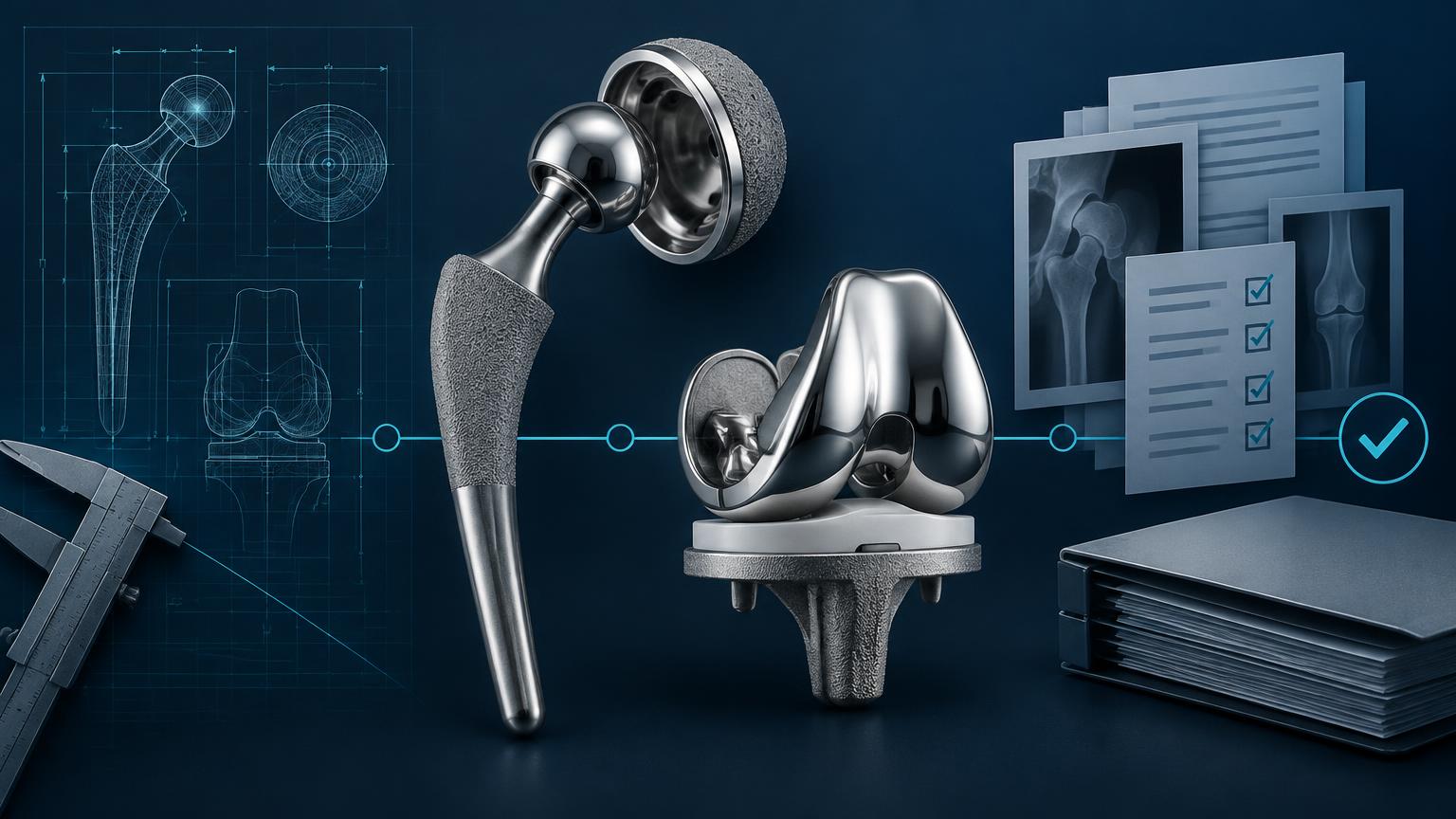
Orthopedic implant development is not a straight line from a promising CAD model to an FDA clearance letter. It is a sequence of connected decisions about clinical need, device classification, predicate selection, materials, mechanical performance, manufacturing and evidence. When those decisions are made separately, teams can reach verification with a design that no longer fits their regulatory strategy.
For many eligible Class II orthopedic implants, a 510(k) submission is the route to US market entry. But not every implant belongs on that pathway. This evergreen guide explains how to connect concept development with an evidence-ready submission—and why clearance should be planned alongside market access, not mistaken for it.
Start with the clinical problem, not the implant geometry
Define the intended patient population, anatomical location, clinical indication and surgical workflow before selecting a material or fixation concept. A hip component for primary arthroplasty, a revision system and a fracture-fixation plate may face different requirements even when they share an alloy.
Translate that clinical purpose into measurable design inputs: dimensions, loading conditions, fixation performance, compatibility, instrument interfaces and labeling. Consider foreseeable misuse, surgical assembly and how surgeons identify compatible components. A narrow, defensible intended use is often more valuable than a broad claim that cannot be supported.
This is also the time to identify adoption constraints. Will the device require new instruments, inventory or surgeon training? A commercially meaningful improvement needs to survive both regulatory scrutiny and the hospital’s purchasing process.
Confirm classification and the appropriate FDA pathway
Use the Product Classification search linked from FDA’s medical-device databases to investigate the relevant regulation, product code, classification and submission requirements. Do not assume a device is eligible for 510(k) simply because a similar-looking implant is already sold.
FDA’s premarket notification overview explains the pathway’s foundation: demonstrating substantial equivalence to a legally marketed predicate device. Some Class III implants require PMA. A novel device without a suitable predicate may warrant consideration of De Novo if its risk profile is appropriate.
Our FDA regulatory pathways guide provides a broader comparison. Classification should be a documented decision supported by current requirements, not an assumption carried over from an earlier product.
Build a defensible predicate and comparison strategy
A predicate is more than a K-number. Review its intended use, technological characteristics, labeling and public decision information. Search the 510(k) records linked from FDA’s medical-device databases and create a comparison matrix covering indication, materials, geometry, fixation, coatings, manufacturing and performance.
Differences are not automatically disqualifying. The important question is whether they raise different questions of safety and effectiveness and whether suitable evidence can support substantial equivalence. Avoid constructing a comparison that borrows one predicate’s intended use and another’s technology without a coherent regulatory rationale.
For example, a porous structure may change fixation behavior, fatigue performance and cleaning challenges. Treat those changes as an integrated evidence problem rather than describing them only as a marketing feature.
Connect risk management with the test plan
For an orthopedic implant, mechanical failure is only one risk. Consider wear, corrosion, particulate generation, loosening, incompatibility, infection, packaging damage and errors during implantation. Use the risk assessment to explain what must be verified and which configurations create credible worst cases.
Bench testing may include static strength, fatigue, wear or fixation assessments, depending on the device. There is no universal orthopedic 510(k) test checklist. The appropriate methods depend on the product code, design, claims, relevant guidance and accepted standards.
Use the FDA standards and conformity-assessment resources to confirm recognition status and limitations. Selecting the largest component as “worst case” without a rationale is not enough; wall thickness, offset, contact mechanics and manufacturing variability may matter more.
Evaluate the finished device, including manufacturing effects
Material familiarity does not eliminate biological evaluation. The FDA guidance on ISO 10993-1 describes a risk-based approach that considers the nature and duration of body contact. Permanent implantation makes material characterization and biological risks especially important.
Evaluate the finished device, including processing residues, surface treatments, cleaning, coatings and sterilization. A change in supplier or manufacturing process can change the evidence needed even when the nominal alloy remains the same.
For sterile implants, establish the sterilization, packaging and shelf-life evidence appropriate to the product. FDA’s sterility-information guidance for 510(k) submissions is a useful planning reference. Do not postpone package validation until the implant design is “finished.”
Use FDA feedback before expensive assumptions harden
A Q-Submission can help when predicate suitability, novel manufacturing, testing or clinical evidence creates material uncertainty. FDA’s Q-Submission Program guidance explains available feedback mechanisms.
Bring specific questions, a proposed approach and supporting reasoning. Asking “What tests do we need?” is less useful than asking whether a defined worst-case strategy addresses a clearly identified concern. FDA feedback is not clearance or a guarantee of the later review outcome.
Clinical data are not required for every orthopedic 510(k), but they may be needed when nonclinical evidence cannot adequately support the comparison. Resolve that possibility before committing to a launch calendar.
Assemble an eSTAR submission from controlled evidence
For most 510(k) submissions, FDA requires the electronic Submission Template and Resource, subject to stated exceptions. The FDA eSTAR resource explains the template and submission process.
The template organizes information; it does not replace regulatory reasoning. Device descriptions, predicate comparisons, test reports, risk assessments and labeling should tell the same story. Claims unsupported by the tested configuration are a frequent source of avoidable inconsistency.
The quality system matters throughout development. Read our companion article, FDA QMSR for Implantable Devices: What Changed in 2026, for the framework now governing those processes.
Clearance is a milestone, not the adoption strategy
FDA clearance does not establish reimbursement, demonstrate hospital budget impact or guarantee value-analysis committee approval. Begin the evidence story for adoption while regulatory work is underway: clinical differentiation, revision risk, operating-room efficiency, instrument costs and service requirements all affect purchasing decisions.
Explore our orthopedic and implantable device specialty for the concept-to-clearance-to-adoption approach. MedTech Copilot supports regulatory planning and structured development questions; MedTech Compass supports market intelligence and adoption strategy. Neither replaces professional judgment or FDA review.
Ready to align your implant concept, predicate strategy and evidence plan? Contact CAHIR or request a demo. This guide is educational, not a device-specific regulatory determination.
Sources
FDA: Premarket Notification—510(k) FDA: Medical-Device Databases—Classification and 510(k) Records FDA: Standards and Conformity Assessment FDA: Biological Evaluation Using ISO 10993-1 FDA: Sterility Information in 510(k) Submissions FDA: Q-Submission Program FDA: eSTAR Program
Follow MedTech Insights
New articles on FDA 510(k) and De Novo pathways, CE Mark and EU MDR, and device reimbursement — sent to your inbox as they publish.