

FDA Form 483 Response Under QMSR: From Observation to Evidence-Backed Action
A practical Form 483 response workflow: assess product impact, distinguish corrections from CAPA, build an evidence index and track commitments with the Cahir MedTech response workbook.
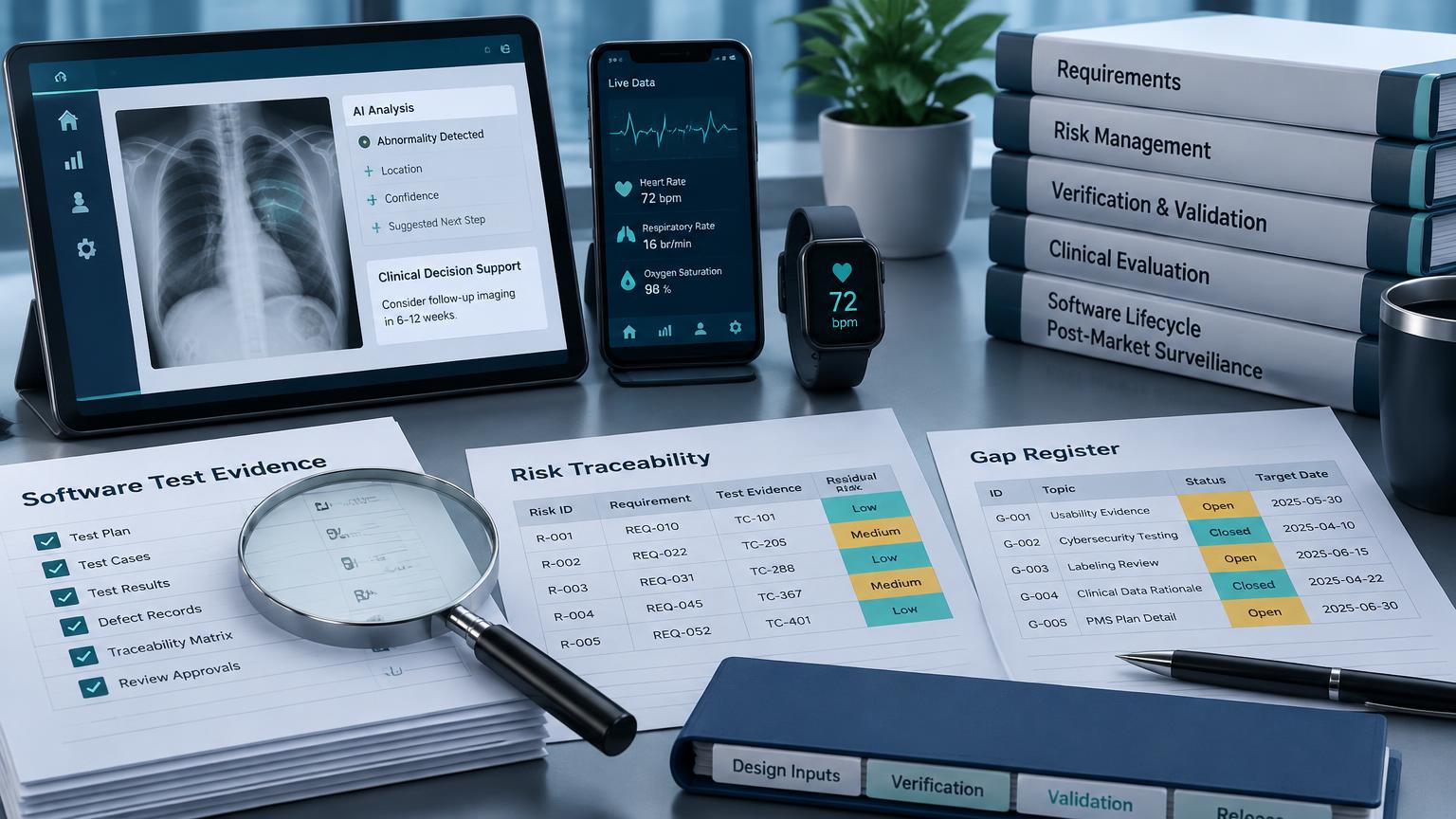
An FDA Form 483 response is an evidence-backed account of what your company found, corrected and still needs to complete after inspection. It is not a promise that every issue is resolved. The strongest starting point is one observation, one accountable owner and one traceable evidence trail.
Form FDA 483 communicates inspectional observations; it is not a final agency determination of a violation. Under QMSR, effective February 2, 2026, device manufacturers need an implemented quality system—not simply a collection of updated procedures. This article explains a practical workflow for using the Cahir MedTech QMSR Form 483 Response Kit without confusing a planning workbook with an official FDA form.
Start with the issued observation, not a rewritten version
Keep the issued wording intact in the Observation Log. Add your factual assessment separately: which process, site, device, lot or software version is involved; what records establish the scope; and which questions remain unresolved. An observation may describe a specific example while the underlying problem extends across several products or procedures.
Appoint a response coordinator and qualified quality/regulatory reviewers. Assign each observation an owner, but do not let separate owners produce contradictory statements about the same process. Use consistent observation numbers and evidence identifiers throughout the workbook. Our QMSR implementation guide explains how records should connect across the quality system.
Plan around FDA's response expectation
FDA CP 7382.850 states that written corrections, corrective-action proposals/plans and evidence of implemented corrections should be submitted within 15 business days after inspection close. Treat this as FDA's stated compliance-program expectation, not a universal statutory deadline. Confirm the actual inspection-close date, submission instructions, applicable calendar and any correspondence with your regulatory lead.
Do not wait for every long-term investigation to finish before organizing a factual response. Separate completed actions from plans, identify appropriate interim controls and give realistic milestone dates. A timely submission does not guarantee acceptance or prevent enforcement. Medical Device Reporting and corrections/removals assessments have separate criteria and deadlines; response preparation must not delay reporting that is independently required.
Move through the workbook in a controlled sequence
Swipe horizontally to see all columns.
| Workstream | Workbook tab | Evidence before review |
|---|---|---|
| Establish ownership | Universal Baseline and Observation Log | Issued wording, scope, owner and requirement references |
| Assess exposure | Product Impact | Device/lot/version scope, risk review and reporting decisions |
| Stabilize the process | Containment Plan | Implemented controls, affected population and release criteria |
| Address recurrence | CAPA Tracker | Investigation evidence, cause assessment and effectiveness plan |
| Draft the firm's position | Executive Response | Factual statements linked to controlled attachments |
| Track follow-through | Commitments and Evidence | Deliverables, dates, evidence revisions and submission confirmation |
The workbook order is a Cahir MedTech recommendation, not an FDA-prescribed response template. Keep approved assessments and source records within your controlled quality system. A link that resolves only to an editable working draft is not equivalent to an approved evidence record.
Distinguish correction from corrective action
A correction addresses a detected problem. Corrective action addresses its cause to prevent recurrence. Updating a record or retraining an operator may be necessary, but it does not by itself establish why the process failed or whether the change will work.
For each proposed action, ask what evidence supports the cause, how broadly the issue extends and how effectiveness will be evaluated. Set the method, acceptance criteria and evaluation timing before claiming success. Where a CAPA is not opened, document the reason using your established procedure rather than assuming every observation requires an identical investigation.
For a SaMD example, suppose a released build lacks an approved validation reference. Determine whether validation actually exists, whether the tested configuration matches the release and whether the missing reference reflects a wider release-control problem. Restoring a link is not a substitute for completing absent validation or assessing affected-product risk. See our complaints, CAPA and risk-management guide for the connected evidence loop.
Review product impact separately from response drafting
Document uncertainty as well as conclusions. Consider distributed lots, deployed software versions, patient exposure and the effectiveness of interim controls. Have qualified reviewers assess whether separate Part 803 reporting or Part 806 obligations apply. Part 821 tracking applies only when its requirements apply to the device; it is not a blanket requirement for every implant.
Select the relevant SaMD, IVD, implantable, capital-equipment or consumable overlay. These prompts help identify questions, not determine compliance automatically. For software, connect the issue to build identifiers, anomalies and risk/validation evidence. An authorized PCCP does not provide unrestricted permission to modify a device.
Make the response auditable before submitting it
- Every issued observation has a factual assessment and accountable owner.
- Completed actions have controlled evidence; open actions have dates and interim controls.
- Product-impact and separate reporting decisions have qualified review.
- Attachment identifiers match the evidence index and approved revisions.
- Appropriate quality, regulatory and executive/legal reviewers approve the response.
- Submission follows FDA's instructions and confirmation is retained.
- Commitments and effectiveness reviews remain assigned after submission.
Avoid unsupported phrases such as “fully compliant” or “permanently resolved.” State what was verified, what remains uncertain and what your next commitment is. Preserve changes to commitments rather than silently replacing an old date.
Put the workflow into practice
The QMSR Form 483 Response Kit is $299 USD one-time; applicable taxes may apply. It provides the response workbook and a branded companion guide. Read the Form 483 companion manual and download its PDF before using the worksheets. Purchase requires a work-email account; the workbook is not a free download or an official FDA submission form.
Use your company workspace to coordinate checklist ownership, notes and activity while retaining detailed evidence and approvals in controlled QMS records. The workspace does not edit the downloaded workbook or submit a response to FDA. For support connecting regulatory questions to evidence review, discuss your workflow with Cahir MedTech Copilot; qualified human review remains essential.
Does completing the kit guarantee FDA accepts the response? No. FDA evaluates the facts, applicable requirements and adequacy of actions. The kit organizes work; it cannot guarantee an inspection classification or enforcement outcome.
What if the root cause is still unknown? Describe the investigation status, evidence collected, interim controls and next milestone. Do not invent a cause or label effectiveness as complete before evaluation.
Primary sources and applicability
- FDA Form 483 Frequently Asked Questions — observations and their significance.
- FDA QMSR overview — effective date and current inspection framework.
- FDA CP 7382.850 — device inspections and written-response expectation.
- 21 CFR Part 820, Part 803, Part 806 and Part 821 — requirements to assess for the actual device and event.
This article provides educational implementation guidance, not legal advice or an FDA-approved template. Use current sources, an authorized copy of ISO 13485:2016 and inspection-specific instructions. Publication date: October 19, 2026; editorial/source review: October 29, 2026.
Follow MedTech Insights
New articles on FDA 510(k) and De Novo pathways, CE Mark and EU MDR, and device reimbursement — sent to your inbox as they publish.