
AI/ML Diagnostics on Novel Sample Matrices: Building the Evidence and the PCCP Together
AI diagnostics that read novel sample types like saliva face three evidence problems at once: the matrix, the model and future model changes. Plan all three before submission, with a free PCCP and evidence planner.
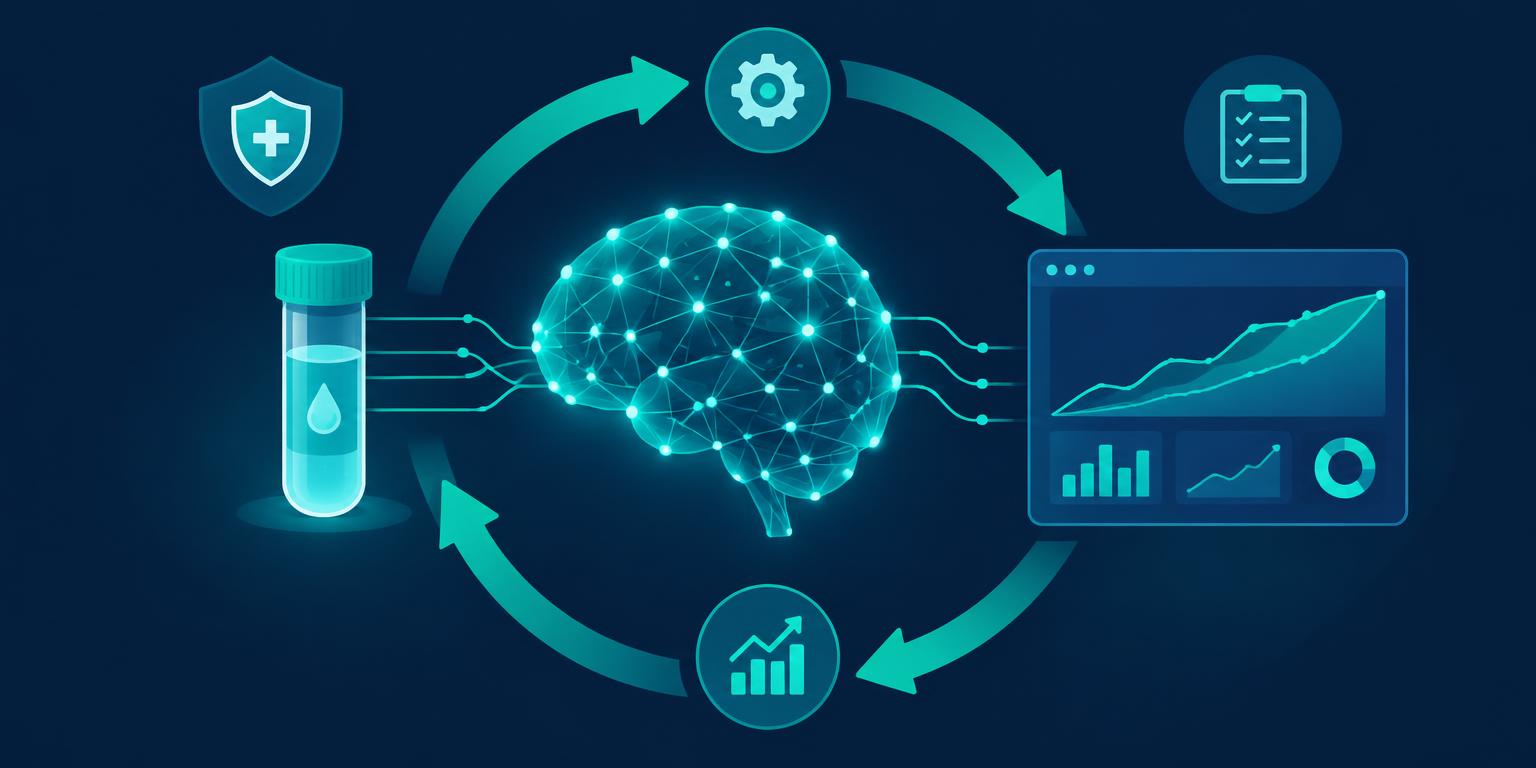
AI-enabled diagnostics that read novel sample types, saliva, breath, capillary blood collected at home, face a compounded evidence problem. The sample matrix has to be validated like any new specimen type. The model has to be validated like any diagnostic algorithm. And because the model will improve over time, you need a plan for which future changes FDA will accept without a new submission. Most teams plan the first two and discover the third too late.
This guide treats all three as one evidence architecture, and introduces the free Cahir MedTech AI/ML Diagnostics PCCP and Evidence Planner.
The matrix problem: validating a novel specimen type
Regulators and payers have decades of precedent for blood and serum. A novel matrix starts with none. Before model performance means anything, you need preanalytical evidence that the matrix itself supports the claim:
- **Stability.** Analyte stability in the matrix across time, temperature and transport conditions that reflect real collection, not just the lab bench.
- **Collection device.** The collection and stabilization device is part of the system; changing it can change results, so it is specified, controlled and validated.
- **Interferents.** Substances common in the matrix, food residue, blood contamination, medications, mucosal transudate variation, tested for clinically significant bias.
- **Population variability.** Matrix composition varies with age, hydration, disease state and time of day; your validation population must reflect the intended-use population.
These are design-control activities, which is why the transition timing in our guide to when R&D becomes regulated development matters here, and why the lot-traceability discipline in QMSR for IVD manufacturers applies even to software-heavy products.
The model problem: dataset and performance evidence
FDA's expectations for AI-enabled devices center on data quality and generalizability, captured in the Good Machine Learning Practice principles developed with Health Canada and the UK MHRA. The practical core:
- **Provenance.** Every training, tuning and test dataset documented: sources, size, demographics, collection devices and sites.
- **Independence.** Test data genuinely separate from training data, with site and device diversity, so performance estimates are not optimistic.
- **Reference standard.** The ground-truth method and adjudication process defined and defensible.
- **Subgroup performance.** Sensitivity and specificity with confidence intervals across demographic and clinical subgroups, not only pooled headline numbers.
Our guides to QMSR design controls for AI/ML devices and radiology AI dataset and clinical validation cover the quality-system and dataset detail. FDA's public list of AI-enabled device authorizations is useful for benchmarking what has been authorized and with what evidence summaries.
The change problem: the predetermined change control plan
A diagnostic model that cannot improve will fall behind its training data. A model that changes freely cannot stay authorized. The bridge is a predetermined change control plan (PCCP): a plan, authorized with the marketing submission, that pre-specifies modifications the manufacturer intends to make, the methods that will verify and validate each one, and how users will be told.
A PCCP has three working parts. The **modification protocol** describes each planned change, its triggers, and the verification methods and acceptance criteria that must pass before deployment. The **impact assessment** defines how each modification's effect on safety and effectiveness is evaluated. The **communication plan** states how implemented updates reach users through labeling and release notes. Our article on PCCPs FDA approved in 2025 and 2026 reviews authorized examples.
Two boundaries matter. A PCCP authorizes only the modifications it describes; anything outside the plan needs a new submission. And a PCCP does not authorize a continuously learning model: the marketed model is locked, and updates are implemented and verified as discrete, documented events.
One architecture, three evidence streams
Swipe horizontally to see all columns.
| Stream | Core question | Typical studies | Where documented |
|---|---|---|---|
| Matrix | Does the specimen type support the claim? | Stability, interferents, collection-device equivalence, population variability | Analytical validation section, DHF |
| Model | Does the algorithm perform as claimed? | Dataset documentation, standalone performance, subgroup analysis, clinical validation | Clinical and software sections, DHF |
| Change | Which future updates stay authorized? | Modification protocol, impact assessment method, monitoring and drift detection | PCCP in the marketing submission |
The streams interact. A matrix change, a new collection device, a broader stability claim, can be a PCCP candidate only if the modification protocol anticipated it. A model retrain is only as good as the dataset governance behind it. Planning the three together is what lets a small team submit once and improve for years.
Worked example: a salivary AI risk-score test
Consider a point-of-care test that measures salivary biomarkers and feeds them to a model that outputs a fibrosis risk score. The matrix stream validates saliva stability in the collection device across a realistic shipping window. The model stream documents training data from multiple sites, locks the test set, and reports subgroup performance across age and disease severity. The change stream proposes a PCCP covering periodic retraining on expanded datasets, with a locked test-set re-evaluation and a non-inferiority margin as the acceptance criterion, plus labeling updates on each deployment.
If the test is novel enough to lack a predicate, the De Novo and CLIA waiver planning in our point-of-care IVD guide applies, and genuinely breakthrough indications may qualify for the programs compared in our breakthrough devices guide. Clearance is only the first commercial hurdle; see why AI devices get cleared but not paid for the reimbursement side.
How to use the free planner
The AI/ML Diagnostics PCCP and Evidence Planner is a branded Excel workbook with a fourteen-item readiness baseline, a PCCP planned-modifications table with verification methods and acceptance criteria, a specimen matrix evidence log, and overlays for five product categories. Download it free with a work email from the toolkits page and track the plan in your company workspace.
For help drafting PCCP modification protocols and dataset documentation, explore Cahir MedTech Copilot. To compare AI device pathways across markets, use MedTech Compass. Keep qualified regulatory, clinical and data-science review in the process.
AI/ML diagnostics evidence: quick answers
What is a predetermined change control plan?
A PCCP is a plan authorized with a marketing submission that pre-specifies modifications the manufacturer intends to make to an AI-enabled device, the verification and validation methods for each, and how users will be informed. Authorized modifications can then be implemented without a new submission.
Does a PCCP allow a continuously learning model?
No. The marketed model remains locked. A PCCP authorizes discrete, pre-specified updates that are verified against acceptance criteria before deployment; it does not authorize a model that changes itself in the field.
What evidence does a novel sample matrix like saliva need?
Preanalytical validation: analyte stability across time, temperature and transport; collection-device equivalence; interferent testing; and performance in a population that reflects intended use, including its natural variability.
What does FDA expect for AI training data?
Documented provenance for every dataset, genuine independence of test data from training data, a defensible reference standard, and subgroup performance with confidence intervals, consistent with the Good Machine Learning Practice principles.
Can a model update ever require a new submission?
Yes. Any change outside the authorized PCCP scope, and any change that fails the PCCP's acceptance criteria, requires a new submission or supplement before implementation.
Is the Cahir MedTech planner an FDA form?
No. It is a free, work-email-gated Excel planning aid. It does not replace FDA submissions, the PCCP guidance, or qualified regulatory and data-science review.
Sources
- FDA: Marketing submission recommendations for a Predetermined Change Control Plan for AI-enabled device software functions
- FDA: Good Machine Learning Practice guiding principles
- FDA: Artificial intelligence-enabled medical devices list
- FDA: Quality Management System Regulation (QMSR)
- FDA: Q-Submission program guidance
Published November 5, 2026. Sources checked for this edition; confirm current FDA requirements for your device. This article and planner are educational planning tools, not legal, regulatory or clinical advice.
Follow MedTech Insights
New articles on FDA 510(k) and De Novo pathways, CE Mark and EU MDR, and device reimbursement — sent to your inbox as they publish.