
Why 331 AI-Enabled Devices Got FDA Clearance in 2025 — and Most Still Aren't Getting Paid
AI device clearances keep climbing while reimbursement barely moves. Here is why the two curves diverge, what payers ask that FDA does not, and what to do about it before your clearance letter arrives.
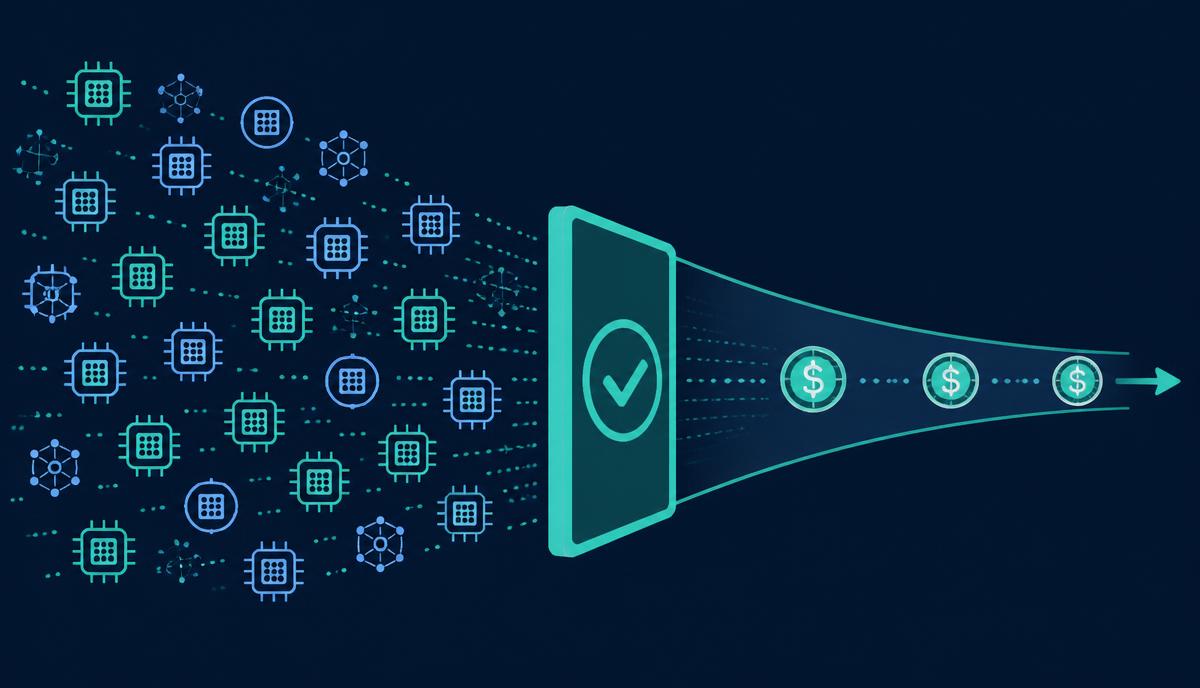
FDA's public list of AI-enabled medical devices keeps getting longer. Hundreds of authorisations landed in 2025 alone, the large majority through the 510(k) route, and radiology remains the dominant specialty by a wide margin. On the regulatory side, AI in medical devices is no longer novel. It is routine.
The payment side has not kept pace. Most cleared AI tools still have no dedicated code, no national coverage policy and no reliable payment amount. Teams celebrate the clearance letter, then discover the harder gate was behind it.
Here is why the two curves diverge.
Clearance and payment answer different questions
FDA asks whether a device is safe and effective, and for a 510(k), whether it is substantially equivalent to a predicate. That is a device question. Our FDA regulatory pathways guide covers how the routes work.
Payers ask a completely different set: does this change what the clinician does, does it change what happens to the patient, does it displace a cost we are already paying, and who exactly is submitting the claim? An algorithm that flags a finding faster does not automatically answer any of those.
The result is a large population of cleared tools whose evidence file was built for a regulator and is being read by a payer.
Why a clearance does not come with a code
There is no automatic code for software. A cleared AI tool typically has three uncomfortable options: fold into an existing service payment and capture nothing extra, pursue a new CPT or HCPCS code with the associated committee timelines, or pursue a temporary add-on payment pathway that expires.
Medicare has begun building structure here. The CY2027 OPPS proposal introduces a dedicated framework for algorithm-driven software — see our post on CMS renaming SaaS to Software as a Medical Service. Separately, the Health Tech Investment Act (S.1399) would legislate a protected payment window for algorithm-based services. Both are meaningful. Neither is in effect yet, and both are narrower than the full population of cleared AI devices.
The evidence gap is real, not rhetorical
Most AI clearances rest on standalone performance: sensitivity, specificity, area under the curve, reader studies against a reference standard. That is what the submission requires.
Very few rest on prospective evidence that the tool changed a clinical outcome, a length of stay, a downstream procedure rate or a cost. Independent reviews of the cleared AI population have repeatedly found that outcome-level evidence is the exception, not the norm.
Payers read that gap exactly the way you would expect. Diagnostic accuracy is not a benefit case. It is a precondition for one.
Who is the billing entity?
This question sinks more AI reimbursement plans than evidence does.
If the tool runs inside a hospital's imaging workflow, the hospital bills, and the software is a cost line rather than a revenue line. If the vendor charges per study or per subscription, that is a procurement conversation with a budget owner who is not the clinician who wants the tool. If the output feeds a physician's interpretation, the professional fee may already cover the work.
Note also that CMS has flagged subscription, licence and per-click pricing structures as a program integrity concern in its SaMS proposal. Pricing model is now a regulatory topic, not just a commercial one.
The hospital budget problem
Even where payment exists, adoption runs through a capital or operating budget with its own committee, its own IT security review and its own competing priorities. A hospital deciding between an AI triage tool and staffing is not evaluating your ROC curve.
What moves that decision is a budget impact model in the buyer's own terms: what it replaces, what it avoids, how many studies a month it touches, and what happens to throughput. Our market access guide sets out the questions buyers actually ask.
What to do differently, starting now
Design the payment evidence into the clinical work. If your validation study is running anyway, add the endpoints a payer needs — downstream utilisation, time to treatment, avoided procedures. Retrofitting outcome data after clearance costs years.
Decide the billing entity before you decide the price. Model the claim path end to end: who submits, under what code, against what payment amount, and what the site of service is.
Track the coding pathway in parallel with the submission. Code applications, coverage requests and payment rulemaking all run on their own calendars. Starting them after clearance guarantees a revenue gap.
Build the cost file early. Both the CY2027 SaMS framework and S.1399 contemplate manufacturer cost data as an input to rate setting. If you cannot document development, hosting, staffing and support cost allocation, you cannot participate in that conversation.
Treat reimbursement as a market selection input. Germany's DiGA route and France's PECAN pathway offer named, time-bound reimbursement for qualifying software — often faster to revenue than the US picture. See international reimbursement pathways.
Plan for model updates. A predetermined change control plan keeps your regulatory position current as the model evolves; a payer will ask whether the version they are paying for is the version that was validated.
The uncomfortable summary
Clearance volume is a measure of how well the regulatory system has adapted to AI. It is not a measure of market traction. Until the evidence, the code, the billing entity and the buyer's budget line up, a cleared AI device is a product with permission to be sold and no mechanism to be bought.
Scoring reimbursement route and evidence readiness alongside regulatory route is what MedTech Compass is built to do, and DevicePath covers the classification and pathway work underneath it. If you want to see how your pipeline looks against both gates, book a demo.
Sources
1. FDA, Artificial Intelligence-Enabled Medical Devices — https://www.fda.gov/medical-devices/software-medical-device-samd/artificial-intelligence-enabled-medical-devices 2. FDA, Artificial Intelligence and Machine Learning (AI/ML)-Enabled Medical Devices — https://www.fda.gov/medical-devices/software-medical-device-samd/artificial-intelligence-and-machine-learning-aiml-enabled-medical-devices 3. FDA, Software as a Medical Device (SaMD), Digital Health Center of Excellence — https://www.fda.gov/medical-devices/digital-health-center-excellence/software-medical-device-samd 4. FDA, Premarket Notification 510(k) — https://www.fda.gov/medical-devices/premarket-submissions-selecting-and-preparing-correct-submission/premarket-notification-510k 5. CMS, Hospital Outpatient Prospective Payment System — https://www.cms.gov/medicare/payment/prospective-payment-systems/hospital-outpatient
This article summarises publicly available regulatory and payment information and is intended as general strategic awareness. It is not legal, regulatory or reimbursement advice.
Follow MedTech Insights
New articles on FDA 510(k) and De Novo pathways, CE Mark and EU MDR, and device reimbursement — sent to your inbox as they publish.
Comments
No comments yet. Be the first to add your read on this.