
HEOR Evidence Requirements by Device Category: SaMD vs. Implantables vs. Diagnostics
Payers and HTA bodies do not apply one evidence standard to medical devices. Here is what the bar actually looks like for software as a medical device, implantables and diagnostics, and how to plan for the one you are in.
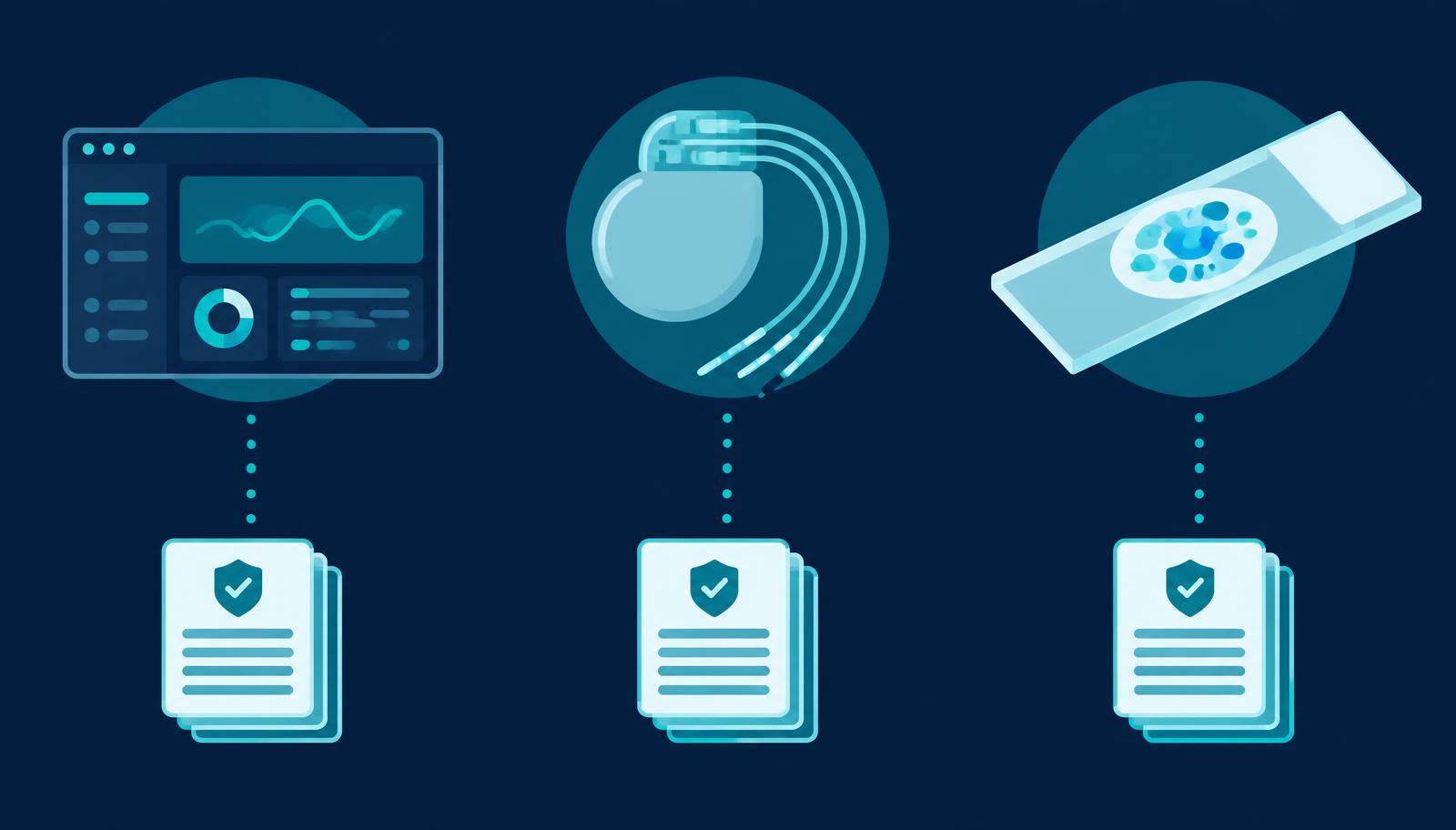
Health economics teams tend to talk about medical device evidence as if it were a single standard. It is not. A payer reviewing a cardiac implant, a diagnostic assay and a piece of clinical software is asking three different questions, using three different comparators, on three different time horizons. Teams that copy an evidence plan from another category usually discover the mismatch at the value analysis committee, which is the most expensive place to discover it.
This is a practical breakdown of what health economics and outcomes research looks like in each of the three main device archetypes, and what to build into your study design before the protocol is locked.
Why category drives the evidence bar
Three structural factors decide how much economic evidence a buyer demands.
The first is how the device is paid for. An implantable usually sits inside a procedure that already has a payment rate, so the economic question is whether it changes the cost or outcome of that procedure. A diagnostic is often paid separately on a fee schedule, so the question is whether the test result changes downstream management. Software frequently has no payment route of its own at all, which is why the argument has to be built on cost offset rather than on a price.
The second is who carries the risk. Implantables carry long-term device-related risk, so payers want durability data measured in years. Diagnostics carry decision risk: a false result propagates into treatment. Software carries workflow and safety risk that shows up only in real use.
The third is how easily the effect can be attributed. A device that replaces a procedure produces a clean comparison. A tool that improves triage produces a diffuse one, and diffuse effects are where value cases fail.
If you are still setting the regulatory route, read the FDA regulatory pathways guide alongside the evidence plan rather than after it. The two decisions constrain each other.
Software as a medical device
For SaMD the hardest part is not proving accuracy. It is proving that better information produced a better and cheaper decision.
Algorithmic performance metrics such as sensitivity, specificity and area under the curve are table stakes for the regulator. Payers treat them as an input, not an outcome. What they ask for is the clinical consequence: fewer unnecessary confirmatory tests, shorter time to treatment, fewer transfers, avoided admissions, reduced reader time. Those endpoints have to be collected prospectively in the same workflow you intend to sell into, because a retrospective dataset rarely captures what clinicians actually did with the output.
Three additional expectations are now routine for SaMD. Evidence of performance across sites and populations, not just the development cohort, because generalisability is the first thing an independent assessor probes. Evidence that the model performs on the deployed version, which connects your evidence plan to your change control — see our PCCP guide for how to structure that. And evidence that the effect persists past the novelty period, which means post-launch real-world data collection, not a single study.
Europe is more explicit about this. Germany's DiGA fast track allows a provisional listing only on the promise of demonstrating a positive healthcare effect within twelve months, and France's route works on a similar conditional logic. We compared both in international reimbursement pathways.
Implantables and capital equipment
Implantables invert the SaMD problem. The clinical evidence is usually strong because the regulatory route demanded it, and the economic argument has to be made against an incumbent device with a known price and a long track record.
Payers and hospital committees want three things. Durability and revision rates over a meaningful horizon, because a device that costs more upfront and lasts longer is a net saving only if the longevity data exist. Procedure-level cost comparison, including operating room time, implant cost, length of stay and complications, because the procedure is the unit the hospital is paid for. And registry participation, which in orthopaedics and cardiology has become close to a precondition for serious consideration.
The important structural point is that inpatient implantables are usually paid inside a bundled rate. That means the hospital captures the saving if your device shortens stay or reduces complications, and the hospital absorbs the cost if your device is simply more expensive. Your economic case has to be framed for whoever holds that bundle, which is why cost-per-case modelling beats cost-per-unit argument every time.
Diagnostics and in vitro tests
Diagnostics have the most distinctive evidence profile, because analytical validity is not clinical utility and payers know the difference.
The evidence chain runs in three links. Analytical validity, that the test measures what it claims. Clinical validity, that the measurement correlates with the condition. Clinical utility, that using the test changes management and improves outcomes. Coverage decisions turn almost entirely on the third link, and it is the one most diagnostics companies underfund.
Add to that the payment reality. Laboratory tests are paid under the Clinical Laboratory Fee Schedule, where rates are set by reported market data and periodic reporting cycles have been repeatedly delayed — we covered the consequences in the PAMA 2026 post. A test that changes treatment but earns a low schedule rate is a viable clinical product and a difficult business, so the economic model has to be built around downstream value captured by someone, and then a plausible story about how that value reaches you.
What to do differently in each category
Write the evidence plan from the buyer backwards. For SaMD, build decision-impact endpoints into the workflow study and plan for continuous real-world collection. For implantables, model at the procedure and bundle level and commit to registry data early. For diagnostics, fund clinical utility deliberately and pair it with a realistic payment model rather than assuming coverage follows accuracy.
In all three cases the cheapest evidence is the evidence you add to a study you are already running. Our market access guide sets out the sequence, and the HEOR primer covers the underlying disciplines.
MedTech Compass scores regulatory route, reimbursement route and evidence readiness together across 25+ markets, so you can see which markets demand a category-specific dossier before you commit budget to them. If that is the decision in front of you, book a walkthrough.
Sources
1. ISPOR — About Health Economics and Outcomes Research: https://www.ispor.org/heor-resources/about-heor 2. FDA — Software as a Medical Device (SaMD): https://www.fda.gov/medical-devices/digital-health-center-excellence/software-medical-device-samd 3. FDA — Use of Real-World Evidence to Support Regulatory Decision-Making for Medical Devices: https://www.fda.gov/regulatory-information/search-fda-guidance-documents/use-real-world-evidence-support-regulatory-decision-making-medical-devices 4. FDA — Premarket Approval (PMA): https://www.fda.gov/medical-devices/premarket-submissions-selecting-and-preparing-correct-submission/premarket-approval-pma 5. CMS — Medicare Coverage Database: https://www.cms.gov/medicare-coverage-database/search.aspx 6. CMS — Clinical Laboratory Fee Schedule: https://www.cms.gov/medicare/payment/fee-schedules/clinical-laboratory-fee-schedule-clfs 7. NICE — Diagnostics guidance programme: https://www.nice.org.uk/about/what-we-do/our-programmes/nice-guidance/nice-diagnostics-guidance 8. NICE — HealthTech programme manual (PMG48): https://www.nice.org.uk/process/pmg48
This article is general information about evidence and reimbursement practice, not legal, regulatory or financial advice.
Follow MedTech Insights
New articles on FDA 510(k) and De Novo pathways, CE Mark and EU MDR, and device reimbursement — sent to your inbox as they publish.