

Design Transfer Under QMSR: From Development Outputs to Controlled Production
Run design transfer as a controlled process: complete production specifications, validated processes, supplier readiness, training and a record-level rehearsal, with an editable readiness checklist.
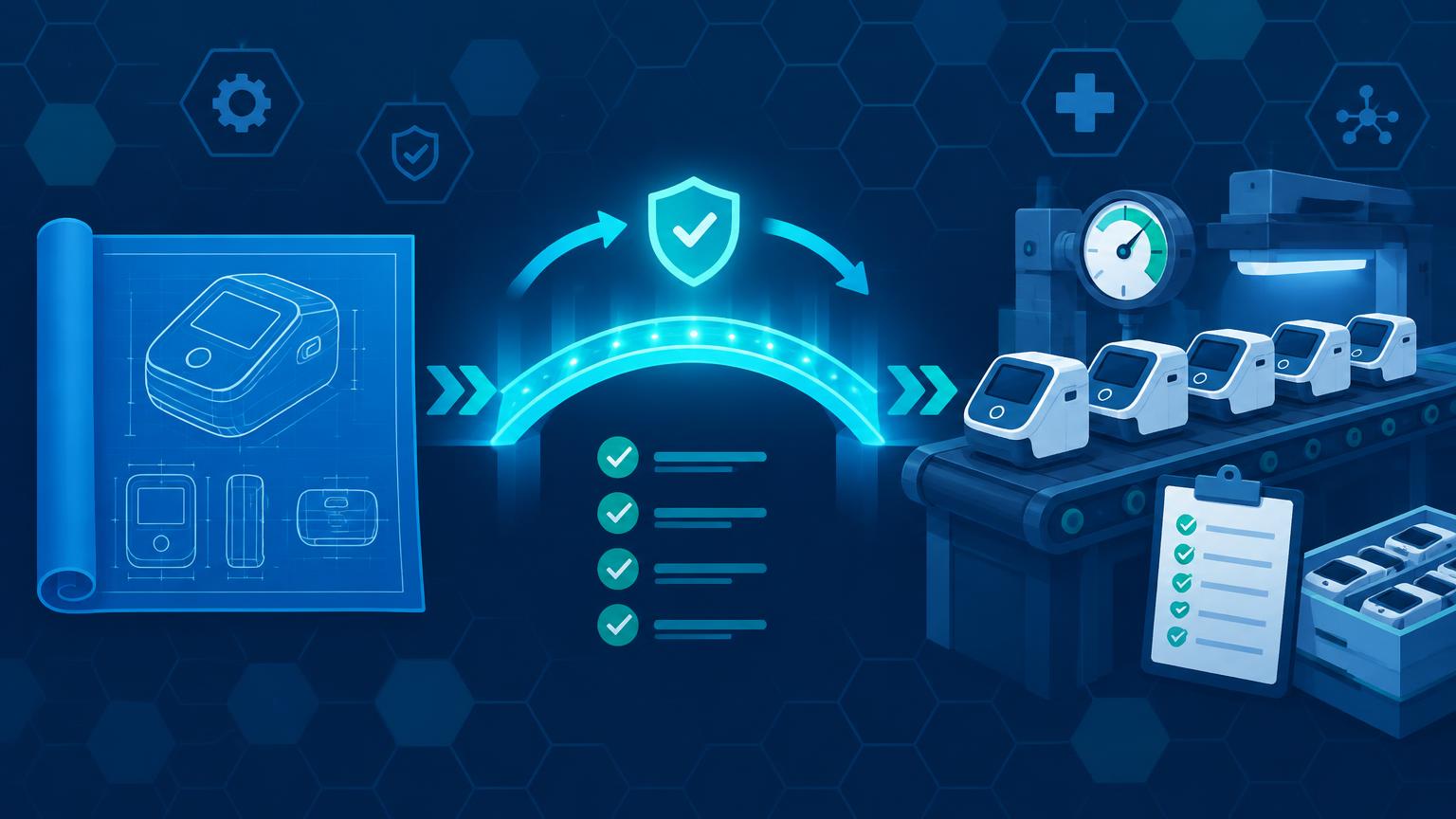
Design transfer is the point where development ends and controlled production begins. Under the Quality Management System Regulation (QMSR)—FDA's quality-system regulation in 21 CFR Part 820, effective February 2, 2026, which incorporates ISO 13485:2016 by reference—transfer is an explicit design-control element: procedures must ensure that design outputs are correctly translated into production specifications. It applies across device categories, from disposables to capital equipment to software-driven products.
The most common transfer failure is treating it as an event—a meeting where engineering hands a drawing package to manufacturing—rather than a process with defined entry criteria, evidence and acceptance. A defensible transfer lets an investigator select one production specification and follow it back to an approved design output, then follow one finished unit forward through materials, processing, inspection and release. This guide lays out practical steps toward that standard; it is preparation guidance, not a guarantee of inspection outcomes.
Define transfer entry criteria before the handoff
Transfer should not start until the design is stable enough to transfer. That does not mean zero open items; it means the open items are visible, risk-assessed and assigned. Practical entry criteria include completed verification, validation evidence on production-equivalent units, closed or dispositioned design-review actions, a current risk management file, and approved labeling content. If the design will continue to change during early production, the change-control boundary—who approves what, under which procedure—must be explicit.
FDA's QMSR overview explains the combined framework, and its inspection approach in Compliance Program 7382.850 directs investigators to test whether design and development controls, including transfer, actually connect to production and process controls. The companion design controls guide covers the upstream evidence that transfer inherits.
Translate outputs into complete production specifications
The core transfer question is whether production specifications faithfully carry the design. Specifications include drawings, component and material requirements, software configurations, work instructions, inspection and test methods, acceptance criteria, packaging and labeling specifications, and servicing instructions where applicable. Each should be current, revision-controlled and traceable to the design outputs it implements.
Test the translation both ways. Pick a design output and confirm it appears in production documentation; then pick a production instruction and confirm it traces to an approved output rather than an undocumented shop-floor practice. Gaps in either direction are findings waiting to happen. Pay particular attention to acceptance criteria that shifted informally during development—tolerances tightened in a test lab but never updated in the released specification—and to software build, configuration and release records that must match what validation actually covered.
Validate processes and confirm supplier readiness
Where process results cannot be fully verified by subsequent inspection or test, the process must be validated with defined parameters, equipment qualification and, where appropriate, revalidation triggers. Transfer is the checkpoint to confirm that validation reflects the transferred design, not a prototype process. The same logic applies to test methods: measurement systems should be capable and calibrated against the acceptance criteria they enforce.
Suppliers are part of the transfer, not a separate workstream. Critical suppliers should hold current specifications and drawings, agreed change-notification obligations and defined acceptance activities, as described in current Part 820 and the incorporated ISO 13485 purchasing clauses. A transfer review should sample one critical purchased component end to end: specification revision, supplier acknowledgment, incoming acceptance results and the supplier's performance history. The six QMS areas inspection guide explains how investigators connect outsourcing and purchasing evidence to design controls.
Train, rehearse and control the post-transfer boundary
People execute transfers. Production, inspection and quality staff need training on the transferred design, the records they will create and the acceptance criteria they will apply—before routine production, with effectiveness confirmed rather than attendance logged. Equipment, tooling and facility readiness should be verified against the transferred specification at the same time.
Then rehearse at the record level. Build or assemble one pilot unit or lot under production conditions and reconstruct its history: materials and their acceptance, processing records and parameters, inspection results, labeling version and release authorization. Weak reconstruction—missing links, unexplained deviations, revision mismatches—identifies exactly what to fix before volume ramps. Finally, hold the boundary: after transfer, design changes move under formal change control with documented impact review, as the QMSR transition roadmap sequences for organizations still stabilizing their systems.
Swipe horizontally to see all columns.
| Transfer element | Evidence to sample | Practical failure signal |
|---|---|---|
| Entry criteria | Verification, validation and review-action status | Transfer started with undisclosed open design issues |
| Specification translation | One output to production document and back | Shop practice not in released specifications |
| Process validation | Validation against transferred design | Validation tied to prototype process |
| Supplier readiness | One critical component end to end | Supplier on old drawing revision |
| Training and rehearsal | Pilot unit record reconstruction | History gaps found after ramp |
Download the design transfer readiness checklist
Download the editable QMSR Design Transfer Readiness Checklist.xlsx. Use it to assign owners, test each transfer element against sample evidence and track gaps to closure. It is a preparation aid, not an FDA form, certification tool or substitute for device-specific regulatory judgment.
- Transfer entry criteria are defined, and open design items are dispositioned.
- Production specifications are complete, current and traceable to design outputs.
- Processes requiring validation are validated against the transferred design.
- Critical suppliers hold current specifications and change-notification terms.
- A pilot unit or lot can be reconstructed from materials through release.
FDA primary sources
Start with FDA's QMSR overview, QMSR frequently asked questions and the Inspection of Medical Device Manufacturers compliance program. Use current 21 CFR Part 820 for binding quality-system text and FDA's recognized consensus standards database for the recognition status of ISO 13485 and related process-validation and risk-management standards.
Make the handoff a controlled, traceable process
Use MedTech Copilot to organize transfer criteria, specification traceability, supplier evidence and pilot-lot reconstruction around traceable decisions. Qualified human owners remain responsible for release, validation acceptance and regulatory determinations. The goal is practical, evidence-backed, inspection-ready implementation—not automated assurance of compliance.
Follow MedTech Insights
New articles on FDA 510(k) and De Novo pathways, CE Mark and EU MDR, and device reimbursement — sent to your inbox as they publish.