
Why Only 16 AI Procedures Have CPT Codes Out of 500+ Cleared Devices
FDA has authorised well over 1,000 AI-enabled devices, but only a handful of AI procedures carry their own CPT code — and most of those codes pay nothing. Here is why the gap exists and what to do about it.
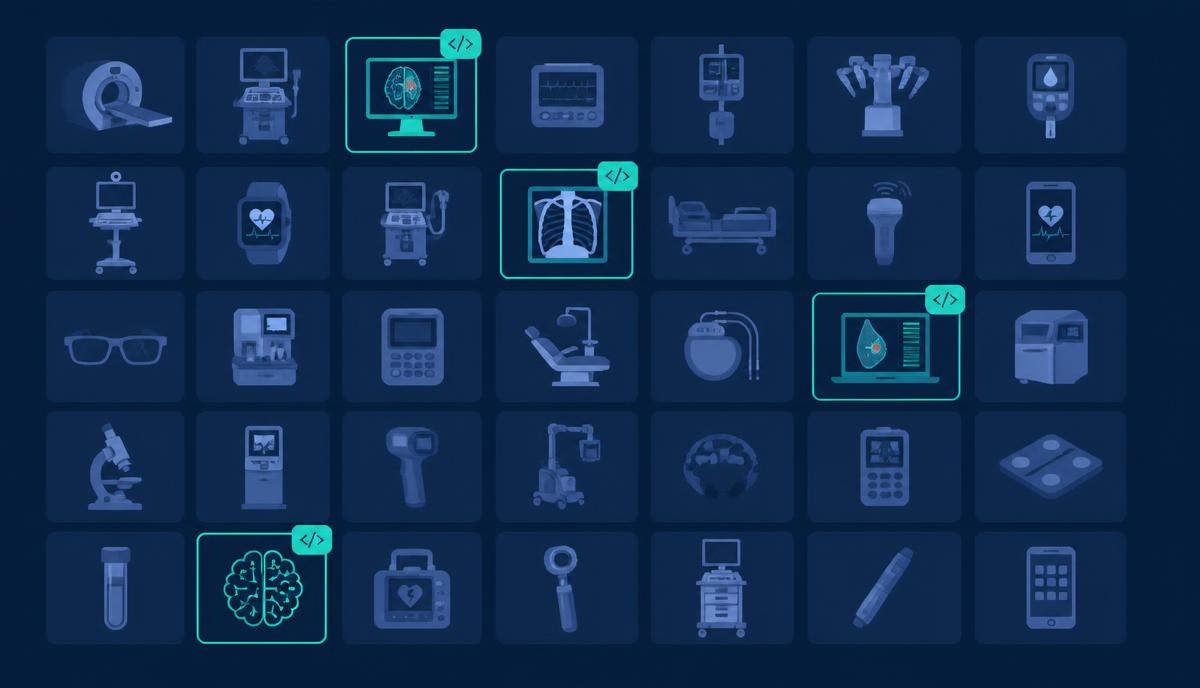
FDA has now authorised well over a thousand AI-enabled medical devices. The agency passed the 500 mark back in 2023 and the list has kept growing every quarter since. Yet the number of AI-enabled procedures that have their own CPT code — the code a physician or hospital actually puts on a claim — is still counted in the dozens, and the number that are separately payable by Medicare is smaller again, somewhere in the mid-teens.
That gap is the single most misunderstood fact in medtech commercialisation. Teams treat clearance as the hard part, then discover that the American billing system has no vocabulary for what they built.
Two different systems, two different gatekeepers
FDA decides whether a device is safe and effective enough to be marketed. That is it. FDA does not decide whether anyone gets paid for using it, and it does not talk to the bodies that do. Our FDA regulatory pathways guide covers what clearance actually buys you.
Payment starts with a code. In the United States, physician and facility procedures are described by CPT, maintained by the American Medical Association through the CPT Editorial Panel. Without a code, there is no clean way to describe the service on a claim, no way for CMS to price it, and no way for a commercial payer to build a coverage policy around it.
The Editorial Panel is not a rubber stamp. It meets three times a year, applications close months in advance, and a Category I code — the payable kind — requires evidence that the service is performed by many providers across the country, that it is consistent with current medical practice, and that the clinical efficacy is documented in peer-reviewed literature. That bar was designed for procedures, not for software that shipped eighteen months ago.
Where the AI codes actually live
Since 2022, CPT has carried Appendix S, a taxonomy that sorts AI-enabled services into three buckets: assistive, where the machine detects something and the clinician does the rest; augmentative, where the machine analyses or quantifies data and produces clinically meaningful output that a clinician still interprets; and autonomous, where the machine reaches a conclusion without concurrent clinician involvement.
The taxonomy tells applicants how to write a code descriptor. It does not create payment. Most of the AI-tagged codes in the current code set are Category III — temporary tracking codes for emerging technology. Category III codes can be billed, but they carry no assigned relative value units, which means payment is contractor-priced or, far more often, denied. They exist to collect utilisation data that might one day support a Category I application. They are a waiting room, not a destination.
Strip out the Category III entries, the add-on codes and the codes that merely reference AI within a broader service, and you are left with roughly sixteen distinct AI-enabled procedures with a real, separately payable pathway. Autonomous diabetic retinopathy screening, fractional flow reserve derived from CT, a few cardiac and imaging quantification services. That is the whole payable universe against a thousand-plus cleared devices.
Why the arithmetic will not fix itself quickly
Four structural reasons.
First, timing. A Category I application needs published evidence of widespread use, and widespread use needs payment. Many AI products cannot generate the utilisation data that would justify the code, because without the code nobody buys at scale.
Second, the unit problem. CPT describes work performed by a person. An algorithm has no work RVUs, no physician time, no malpractice component. The valuation machinery that sets Medicare rates was built for labour, supplies and equipment, and it does not know what to do with a licence fee. CMS acknowledged exactly this in its CY2027 OPPS proposal, which is why the agency floated a new Software as a Medical Service category and an O1 payment indicator as an interim bridge.
Third, packaging. In the hospital outpatient setting, many AI services are bundled into the payment for the underlying imaging study or encounter. The hospital can use the software, but the payment does not increase, so the software has to justify itself through throughput or quality rather than revenue.
Fourth, the legislative route is unfinished. The Health Tech Investment Act (S.1399) would create a statutory payment category for algorithm-based healthcare services with a five-year protected payment window. It remains pending in the Senate Finance Committee.
What this means for your plan
If your commercial model assumes a code appears because the device is cleared, the model is wrong. Three adjustments are worth making before your next board meeting.
Decide early whether you are pursuing a code or selling into an existing one. Many successful AI products never get their own code; they make an existing billable procedure faster, more accurate or performed more often, and the business case goes to the provider as cost avoidance, throughput or quality-measure performance. That is a legitimate strategy and it is available now.
If you do want a code, start building the evidence file at the same time you build the submission file, not after. Multi-site utilisation data, peer-reviewed outcomes, and a clear statement of who performs the service and in what setting are the raw material of a code application. Our market access guide sets out the sequence.
Model the non-US routes in parallel. Germany and France built named reimbursement lanes for software with defined evidence windows and guaranteed payment periods, which our international reimbursement pathways piece compares side by side. For some products the first paid market is not the United States, and the EU MDR and UKCA route becomes the priority.
Closing
Sixteen payable AI procedures against a thousand cleared devices is not a temporary backlog. It is what happens when two systems with different purposes, different evidence bars and different clocks are asked to work together. The teams that plan for both from day one are the ones whose products get used.
MedTech Compass scores markets on regulatory and payment friendliness together, and DevicePath helps map the classification and pathway questions that sit underneath all of this.
This article is general strategic awareness, not legal, coding or reimbursement advice. Code counts and payment status change with each CPT release; confirm the current position before relying on it.
Sources
CPT Editorial Panel strengthens AI taxonomy to keep pace with tech, American Medical Association
Artificial Intelligence-Enabled Medical Devices, US Food and Drug Administration
Hospital Outpatient Prospective Payment System, Centers for Medicare and Medicaid Services
HCPCS Quarterly Update, Centers for Medicare and Medicaid Services
Follow MedTech Insights
New articles on FDA 510(k) and De Novo pathways, CE Mark and EU MDR, and device reimbursement — sent to your inbox as they publish.
Comments
No comments yet. Be the first to add your read on this.