
CE Mark vs. FDA Clearance: Key Differences for MedTech Market Entry Strategy
CE marking and FDA clearance are not two versions of the same approval. Here is how the evidence, timelines, oversight and market-entry sequencing actually differ, and how to decide which one to pursue first.
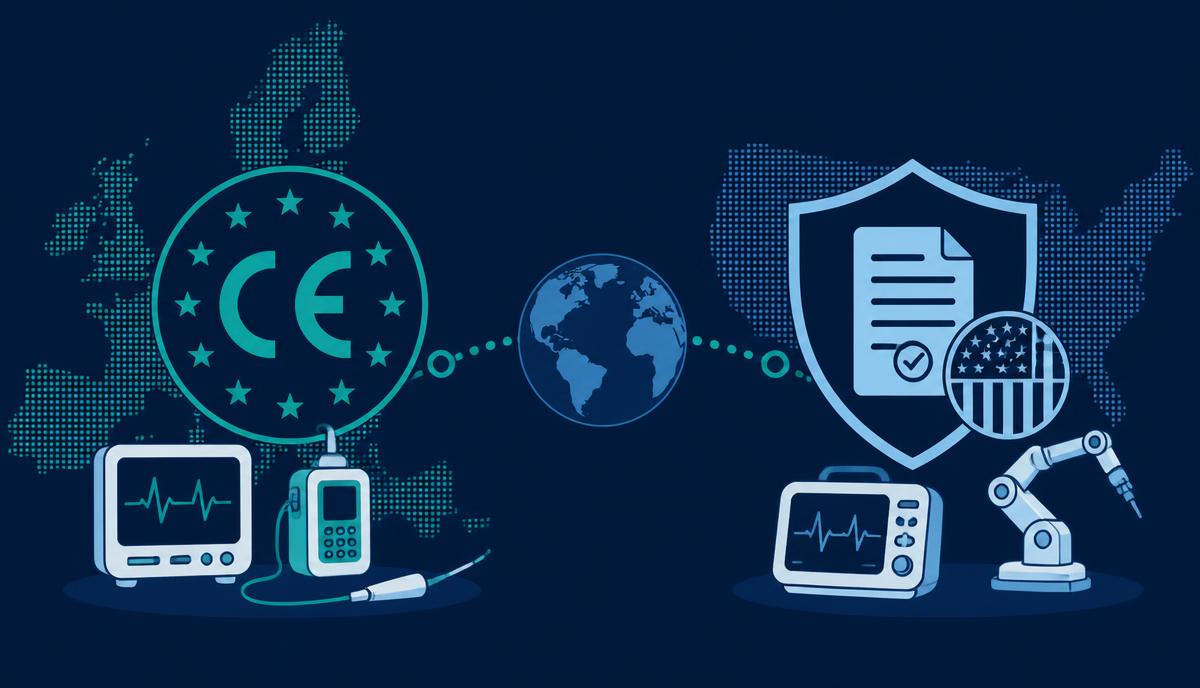
Most medtech teams eventually ask the same question: do we go to Europe or the United States first? The answer is rarely a coin toss, and it is almost never decided by which submission looks easier on paper. CE marking and FDA clearance are structurally different systems, with different gatekeepers, different evidence expectations and very different consequences for how fast you can actually sell.
Here is what separates them, and how that difference should shape your market entry strategy.
Two different models of oversight
FDA clearance is a government decision. For most moderate-risk devices, you file a 510(k) premarket notification and the agency itself reviews it, then issues a clearance letter that says your device is substantially equivalent to a legally marketed predicate. Nothing goes on the US market until FDA says so. See our FDA regulatory pathways guide for how 510(k), De Novo and PMA differ.
CE marking is a conformity assessment. You, the manufacturer, declare that your device conforms to the EU Medical Device Regulation. For anything above the lowest risk class, a notified body — a private organisation designated by an EU member state — audits your quality system and technical documentation and issues a certificate. There is no single government approval letter. Our EU MDR and UKCA compliance guide walks through classification and the notified body route.
That distinction matters more than it sounds. In the US you are persuading one reviewer at one agency against a comparative standard. In the EU you are proving, to an auditor, that your entire quality system and clinical evaluation satisfy a regulation in its own right.
The evidence bar is framed differently
The 510(k) question is comparative: is your device as safe and effective as a device already on the market? Much of the work is predicate selection, comparison tables and bench or performance testing. Clinical data is required less often than people expect.
EU MDR does not ask a comparative question at all. It asks whether your device meets the General Safety and Performance Requirements, and it expects a clinical evaluation supported by clinical data for your device or a demonstrably equivalent one. Equivalence claims are far harder to sustain under MDR than they were under the old directives, and post-market clinical follow-up is a standing obligation, not a closing task.
The practical effect: a device with a clean predicate and solid bench data can move faster in the US. A device with real clinical outcome data but a weak predicate story can find Europe more receptive.
Timelines and what actually drives them
US 510(k) review has a published performance goal measured in months, and the clock is reasonably predictable once you file. What delays teams is usually the additional information request, not the agency's calendar.
CE marking timelines depend on notified body capacity, which has been the sector's bottleneck since MDR came into force. Securing a slot with a notified body that is designated for your device codes can take longer than the technical review itself. Treat notified body availability as a scheduling input, not an administrative detail.
Cost structures are not comparable line by line
FDA charges a user fee per submission, with substantial small-business reductions, and the direct fee is a small share of total cost next to testing and consulting. Our post on De Novo classification fees breaks down how the fee tiers work.
CE marking has no central fee. You pay the notified body for assessment and for ongoing surveillance audits, plus the cost of maintaining an ISO 13485 quality system, appointing a Person Responsible for Regulatory Compliance, and holding an authorised representative if you are outside the EU. It is a recurring cost, not a one-time charge.
After approval, the obligations diverge again
A 510(k) clearance is essentially open-ended. You maintain your quality system, report adverse events, and file a new submission if you make a change that significantly affects safety or effectiveness. For AI-enabled devices, a predetermined change control plan can let you ship pre-authorised model updates without a new submission.
A CE certificate expires. It is valid for a fixed term, renewed through recertification, and maintained through annual surveillance audits, periodic safety update reports and post-market clinical follow-up. Europe assumes you will keep generating evidence after launch.
Clearance is not payment in either market
This is where most market entry plans go wrong. Neither a CE certificate nor an FDA clearance tells you anything about whether someone will pay for the device.
In the US, coding and coverage are handled separately, case by case. In Europe, payment is decided country by country, with national routes such as Germany's DiGA and France's PECAN for digital health — covered in our post on international reimbursement pathways. A CE mark gets you the legal right to sell in 30 countries; it gets you paid in none of them automatically. Our market access guide sets out what payers ask that regulators do not.
How to choose your sequence
Four questions usually settle it.
Where is your evidence strongest? Strong predicate, bench-heavy data leans US. Strong clinical outcomes data leans EU.
Where is your first revenue realistically coming from? Sequence toward the market where you have a named buyer, not the market with the shortest review.
What does your device class demand? A low-risk device that is self-certifiable in the EU is a very different calculation from a Class IIb device needing full notified body involvement.
Can your organisation carry two quality systems at once? ISO 13485 and FDA's Quality Management System Regulation have converged, but running both submissions simultaneously with a small regulatory team is how timelines slip in both.
Doing this systematically
Comparing entry routes market by market, on evidence readiness and payment prospects rather than on submission mechanics alone, is exactly what MedTech Compass is built for, and DevicePath handles the classification and pathway triage that sits underneath it.
The short version: CE marking and FDA clearance are not interchangeable milestones. Pick the one your evidence, your buyer and your team can actually support first, then build the second submission from what you learn.
Sources
1. FDA, Premarket Notification 510(k) — https://www.fda.gov/medical-devices/premarket-submissions-selecting-and-preparing-correct-submission/premarket-notification-510k 2. FDA, How to Study and Market Your Device — https://www.fda.gov/medical-devices/device-advice-comprehensive-regulatory-assistance/how-study-and-market-your-device 3. Regulation (EU) 2017/745 on medical devices (MDR), EUR-Lex — https://eur-lex.europa.eu/legal-content/EN/TXT/?uri=CELEX%3A32017R0745 4. European Commission, Medical devices — new regulations — https://health.ec.europa.eu/medical-devices-sector/new-regulations_en 5. FDA, Premarket Approval (PMA) — https://www.fda.gov/medical-devices/premarket-submissions-selecting-and-preparing-correct-submission/premarket-approval-pma 6. FDA, Medical Device User Fee Rates for Fiscal Year 2026, Federal Register — https://www.federalregister.gov/documents/2025/07/30/2025-14412
This article summarises publicly available regulatory information and is intended as general strategic awareness. It is not legal or regulatory advice.
Follow MedTech Insights
New articles on FDA 510(k) and De Novo pathways, CE Mark and EU MDR, and device reimbursement — sent to your inbox as they publish.
Comments
No comments yet. Be the first to add your read on this.